NIT RourkelaSipradi TradingMahindraDugar Auto Clinic4D ProductsNIT RourkelaSipradi TradingMahindraDugar Auto Clinic4D Products
Selected work · 2019—2026
A versatile background in manufacturing, product design & engineering.
EV production lines in Pune, heavy-truck drivetrains, hospital VR in Liverpool, a toy locomotive reverse-engineered in CAD, and a studio bench in Kathmandu. Different industries and different tools, with the same aim throughout: building things people can actually use.
Filter
Where I've worked
01Featured
Featured project
Manufacturing
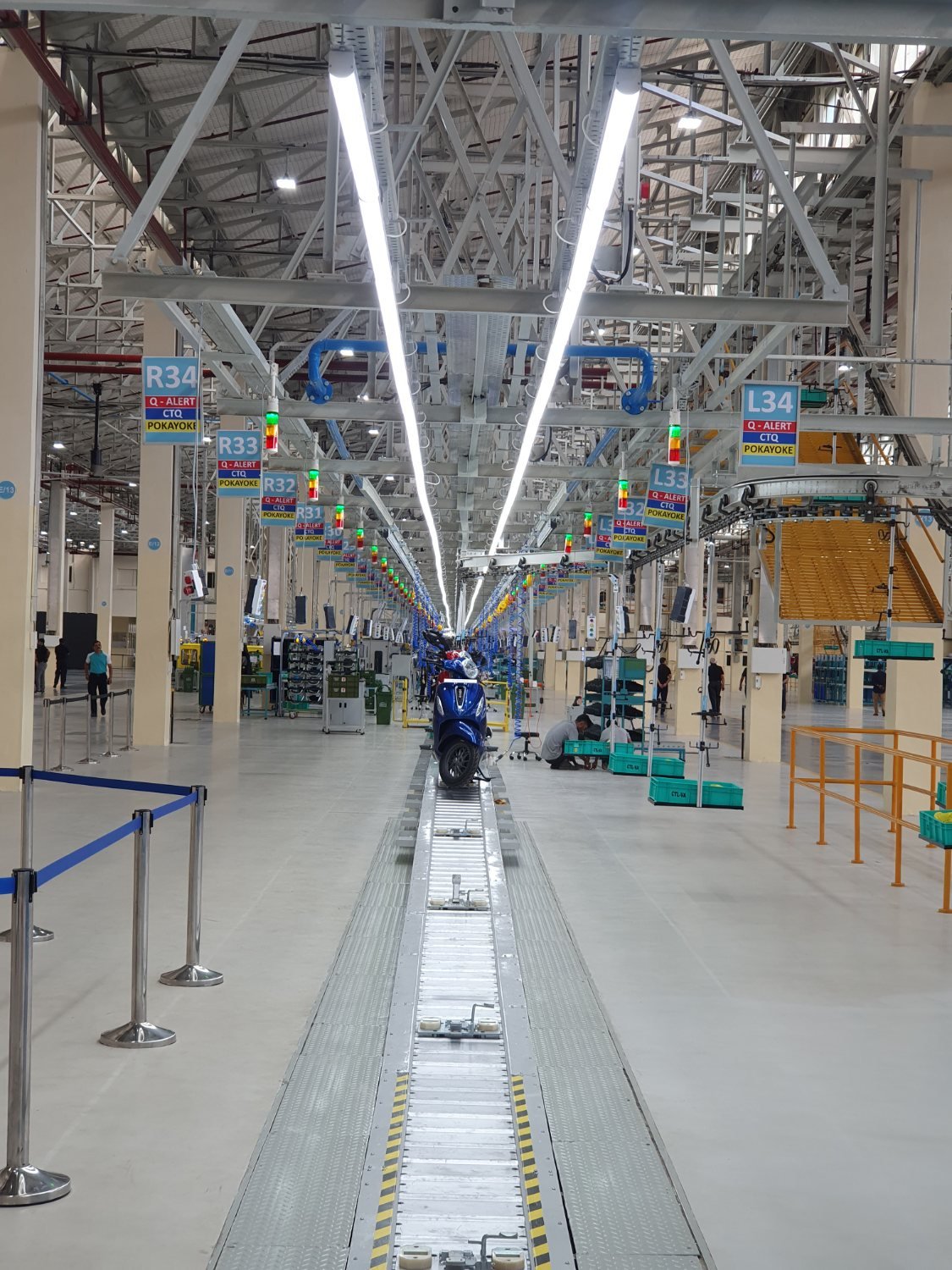
Scaling next-generation EV manufacturing for the electric Chetak.
A greenfield EV assembly plant for Bajaj's Chetak, taken from layout to line-off in five months, at £43M and 62 suppliers, on the same ground where the original Chetak was built. Senior management handed me the project, and we delivered it.
As seen in The Times of India · Hindustan TimesRead the case study →
02Featured
Featured project
Healthcare · Medical device
IRIS, an immersive VR headset built to replace the radiotherapy mask.
A VR immobilisation system for head-and-neck cancer patients, designed to take the fear out of the thermoplastic mask. I carried it from patient research through CAD, prototyping and MR and radiation safety testing into a clinical-trial-ready headset, built for under £4k and saving 80% of the equipment budget.
Presented at UKIO 2026, LiverpoolRead the case study →
More projects04 selected
"Some of this work built the portfolio, and some of it built the person. Both are here."
Click anywhere outside to return · Esc
Chetak EV final-assembly line · line-off ready · Akurdi, Pune
Manufacturing · Bajaj Auto · Chetak EV
Scaling next-generation EV manufacturing: a greenfield Chetak line.
Bajaj Auto · Chetak EV · Akurdi, Pune
Bajaj Auto's senior leadership gave me end-to-end ownership of a greenfield EV assembly plant, from layout to line-off, for the electric Chetak. It was a £43M facility with five product launches, 62 suppliers, and a five-month timeline, built on the same ground where the original Chetak was made. This is how it came together.
Role
Project & manufacturing engineer
Investment
£43M greenfield
Build time
5 months to line-off
Scale
62 suppliers · 8+ departments
ManufacturingGreenfield projectEV mobility
In the press
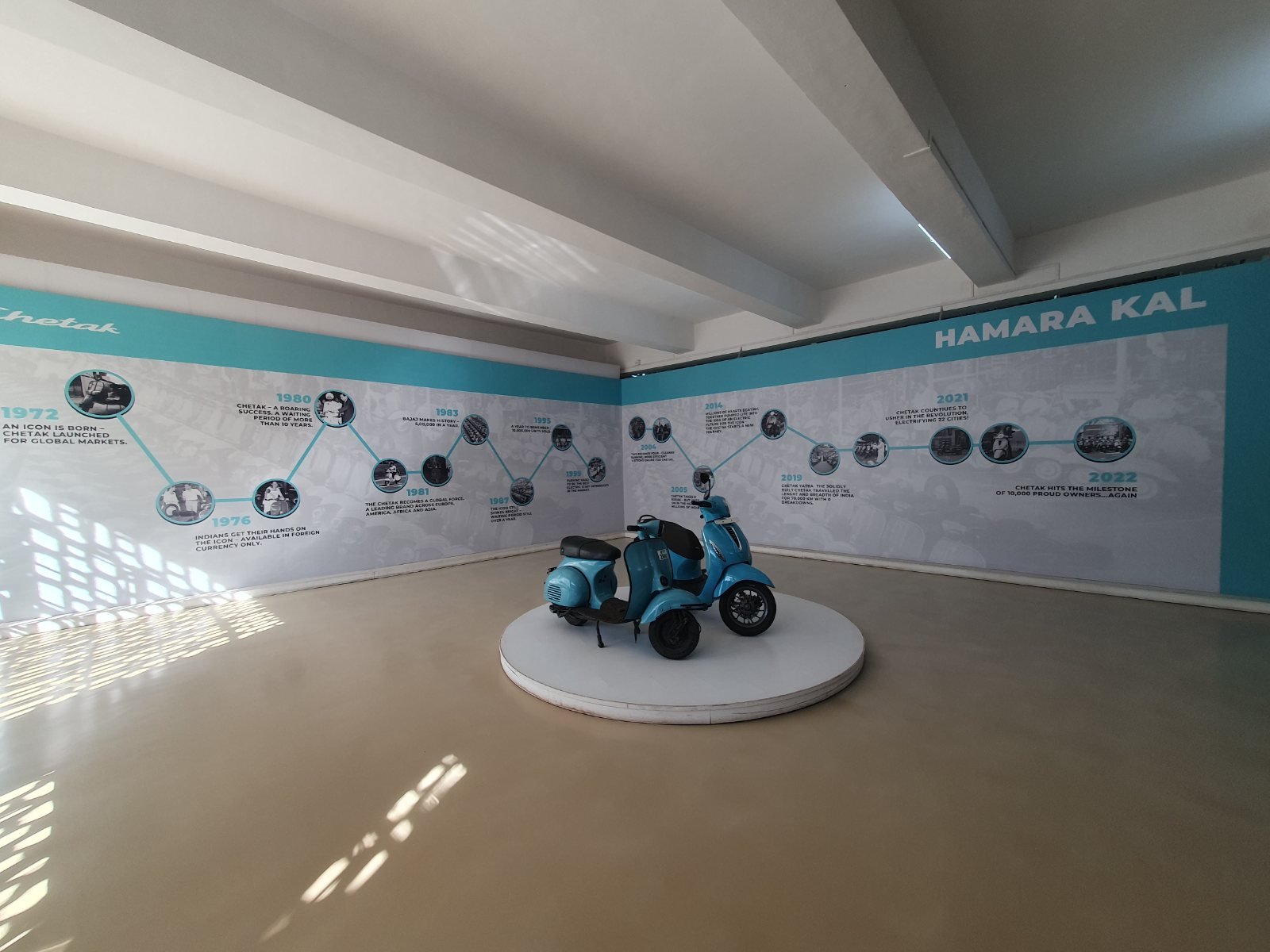
“Hamara Kal”, the Chetak timeline, 1972 to today
Historic ground
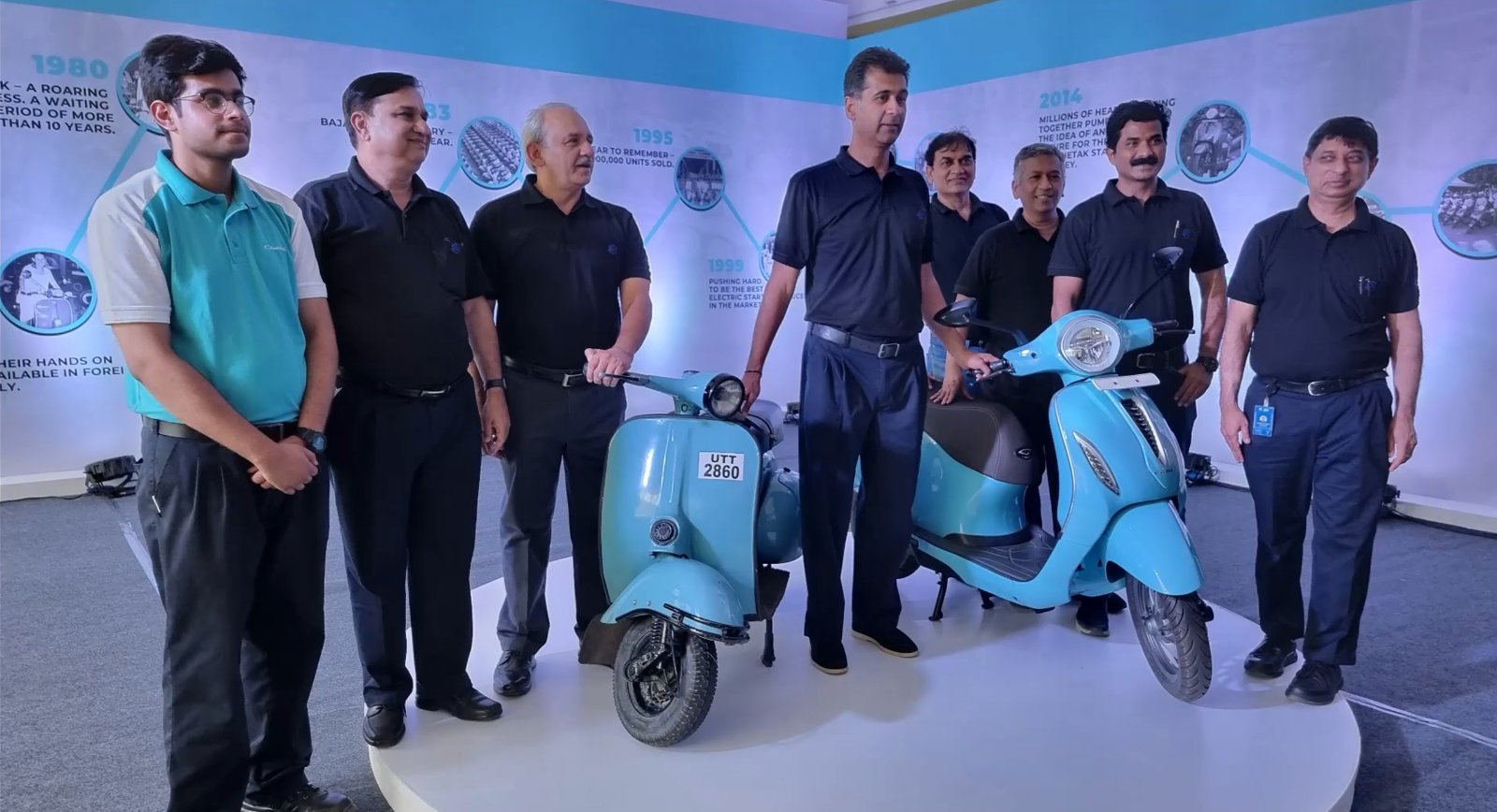
The line was built inside the same Akurdi works where the original Chetak was made, the scooter that carried Bajaj through its early decades and put a generation of India on two wheels. The heritage wall traces that history, from 1972 to now.
Building the electric Chetak's plant on that exact site meant a lot to the team, and it set the standard for the work.
“Every Chetak I see on the road today, anywhere in the world, rolled out of the plant I set up. I am proud of that.”
On the electric Chetak
The challenge
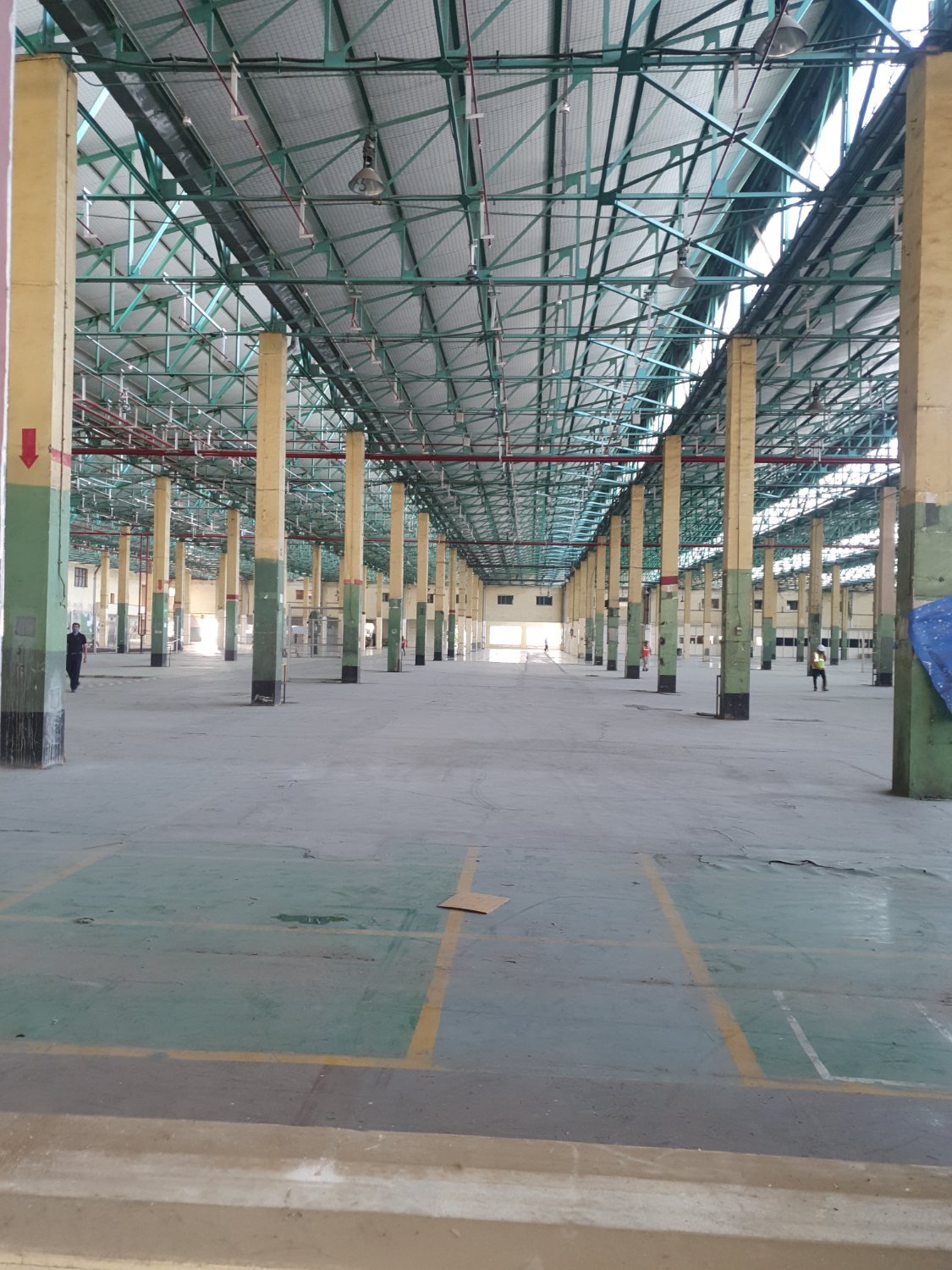
When I first walked in, the space was a bare, decades-old shed with columns, a roof, and nothing else. Five months later it was a live EV assembly line running to CTQ and poka-yoke standards. Everything in between, from layout and budget to equipment, procurement, installation, and commissioning, sat on the project.
BeforeDay zero, the bare shedAfterMonth five, a running EV line
The engineering
Standing a plant up on that timeline meant running the design engineering and the physical build in parallel across four workstreams on one line.
5 launches
GD&T & design reviews
Applied GD&T to interrogate part drawings and led design reviews across five EV two-wheeler launches, then designed the custom assembly tools, fixtures and machinery each one needed on the line.
100+
Engineering change requests
Delivered 100+ ECRs through PLM, keeping part revisions precise and folding every new model cleanly into the design documentation without disrupting the running line.
1000+
Components, fully BOM'd
Built comprehensive multi-level Bills of Materials for 1000+ components, giving production and procurement one clean source of truth to plan and buy against.
95%
Line readiness at handover
Ran the design-engineering studies, process documentation and material planning that took the line to 95% readiness, optimising DFA and CTQ across 8+ departments and 62 suppliers.
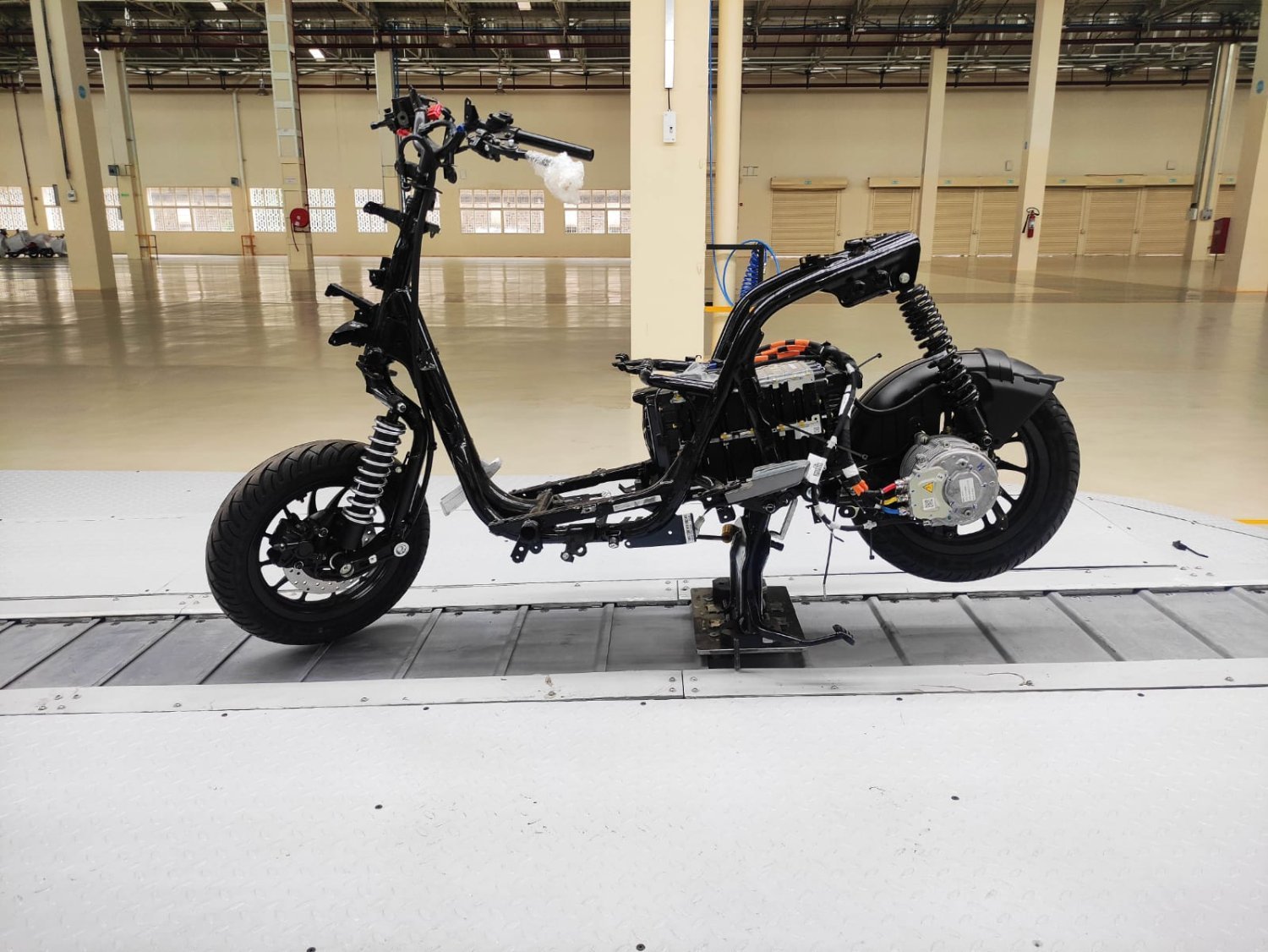
Chassis, battery and hub-motor coming together on the line
Greenfield, end to end
I led the greenfield build for the £43M assembly plant top to bottom, covering layout design, budgeting, equipment design, procurement and installation, and brought the facility online in five months.
The first time an EV chassis, battery pack, and hub-motor came together on the conveyor, we knew the line was working. Everything after that was rhythm.
Signed off
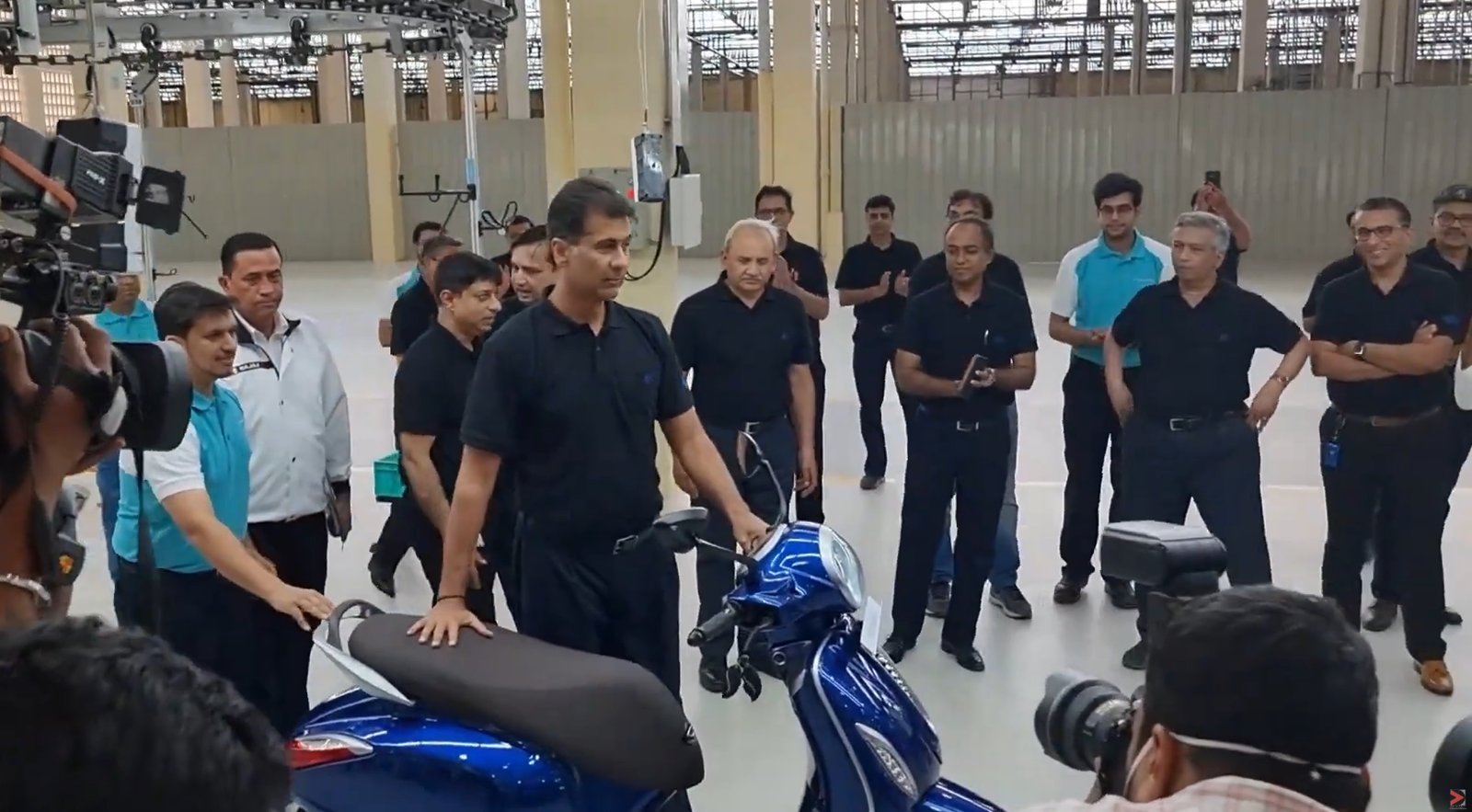
When Bajaj's senior management walked the finished line for the first line-off, the plant they were standing in had not existed five months earlier. Delivering it on time, to standard, and on ground this significant is the part I will carry.
Covered nationally
Senior management at the first line-offPast and present, the original Chetak beside the new EV
Impact
£43M
greenfield facility delivered
5 mo
from bare shed to line-off
95%
line readiness at handover
5
EV product launches supported
100+
ECRs delivered via PLM
1000+
components in multi-level BOMs
62
suppliers · 8+ departments aligned
Manufacturing · Tata Motors · Sipradi
Engineering out the drivetrain bottleneck in heavy commercial trucks.
Tata Motors · Sipradi · Commercial vehicles
A manufacturing case study on heavy-truck drivetrain and chassis integration, where propeller-shaft misalignment during assembly and servicing was costing millions. The fix came in two parts: a tighter assembly process and a design that could tolerate real-world tolerances.
Role
Manufacturing engineer
Focus
Drivetrain integration
Where
Commercial vehicles
ManufacturingTooling & processChassis design
The problem
In heavy-duty commercial vehicles, drivetrain alignment during assembly and servicing was a major bottleneck.
Trial-and-error shimming consumed 3–4 hours per vehicle.
Field failures led to warranty costs of ~$7M / year.
Thinking process
Collected assembly and field-failure data to locate the true source.
Found that tolerance stack-ups from chassis frame-rail welding and axle mounting holes were the biggest contributors.
Explored a dual approach: better assembly process control paired with tolerance-resilient design.
Process & tooling solution
Introduced laser alignment tools for propeller-shaft and axle fit-up.
Developed a modular axle positioning jig to precisely locate axle brackets on the chassis.
Standardised the shimming process with pre-calibrated spacers.
Design solution
Redesigned propeller-shaft couplings with double-cardan joints for more misalignment tolerance.
Modified chassis rails to include machined datum slots at axle brackets.
Reduced the number of shimming points by consolidating into adjustable eccentric bushings.
Results
−65%
alignment time
−70%
assembly fit-up time
−50%
warranty claims
−60%
customer downtime
+15%
productivity
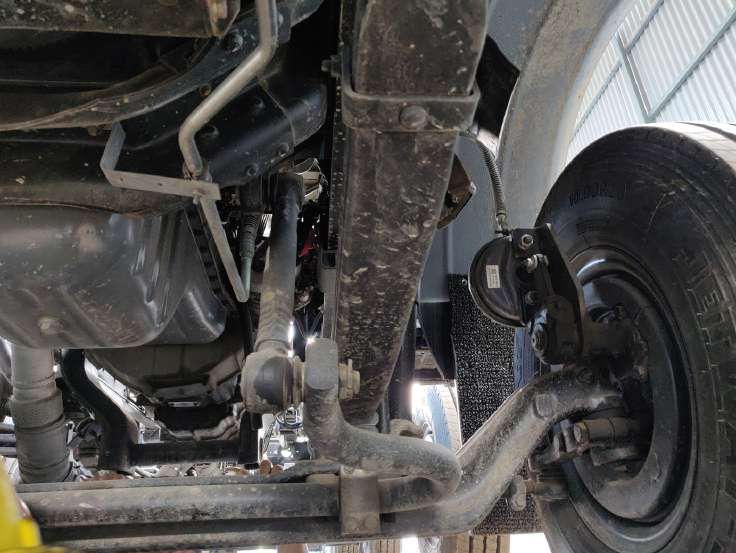
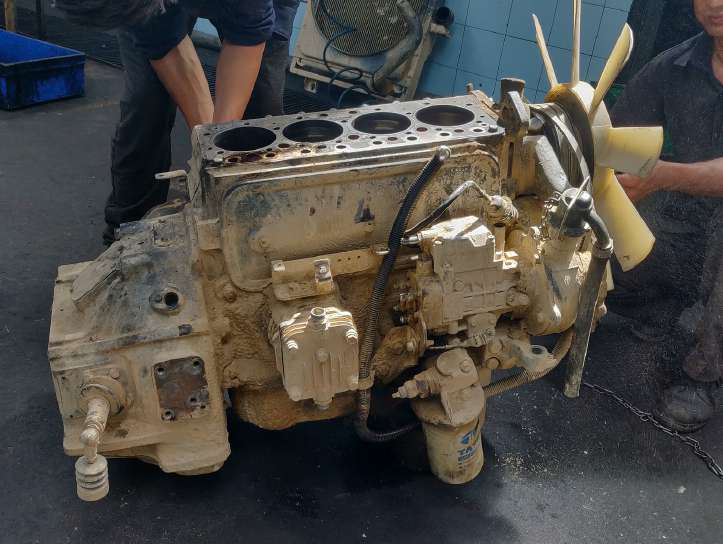
Drivetrain & propeller-shaft assemblyEngine & gearbox during servicing
IRIS · immersive radiotherapy immobilisation system · University of Liverpool
Healthcare · Medical device · University of Liverpool
IRIS: replacing the radiotherapy mask with an immersive VR headset.
University of Liverpool · Head & neck radiotherapy · Liverpool, UK
Head and neck cancer patients are clamped to the treatment couch by a rigid thermoplastic mask, every day, for weeks. For many of them the mask is the most frightening part of their care. IRIS is my answer to that: an open, immersive VR headset that holds the head still without the mask and gives the patient a calm world to look into instead of the machine. I owned the physical product, from patient research and concept through CAD, prototyping and MR and radiation safety testing, and delivered a headset ready to take into a clinical trial.
Role
Product design engineer
Focus
Medical device · VR hardware
Where
Liverpool, UK
Recognition
UKIO 2026 · paper in progress
Medical deviceVR & opticsCAD & prototyping
The problem
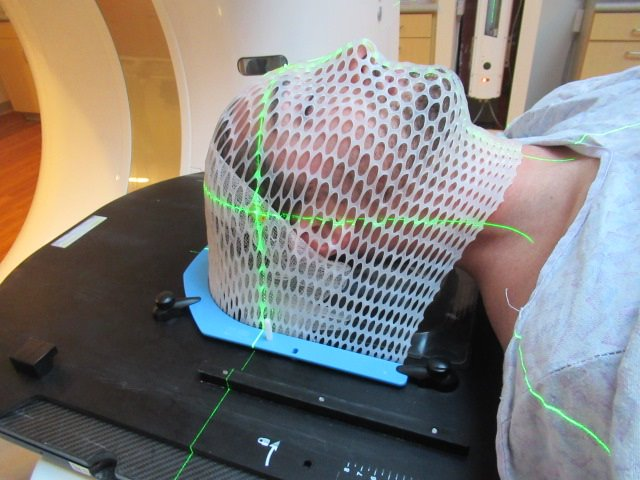
Around 12,000 people are diagnosed with head and neck cancer in the UK every year, and most will be treated with radiotherapy. To aim that radiation precisely, the patient's head is fixed to the couch with a custom thermoplastic mask, a tight mesh that hardens over the face and neck and bolts down at the edges. It is worn for every session across roughly six weeks of treatment, on skin that is already sore.
When I read the patient research, the same word kept coming up: fear. Roughly 4 in 10 radiotherapy patients report anxiety, and studies of head and neck patients describe crying, shaking, panic and claustrophobia under the mask. A 2024 study found a third of patients scored above the clinical threshold for anxiety during treatment, some needed sessions interrupted, and others needed sedation just to lie still. That anxiety is not only distressing, it slows treatment and can compromise it.
12,000
new UK head & neck diagnoses / year
~40%
of radiotherapy patients report anxiety
6 wks
of daily masked treatment
1 in 3
above the clinical anxiety threshold
TodayThe thermoplastic mask, clamped for every sessionIRISIRIS: an open headset, no mesh over the face
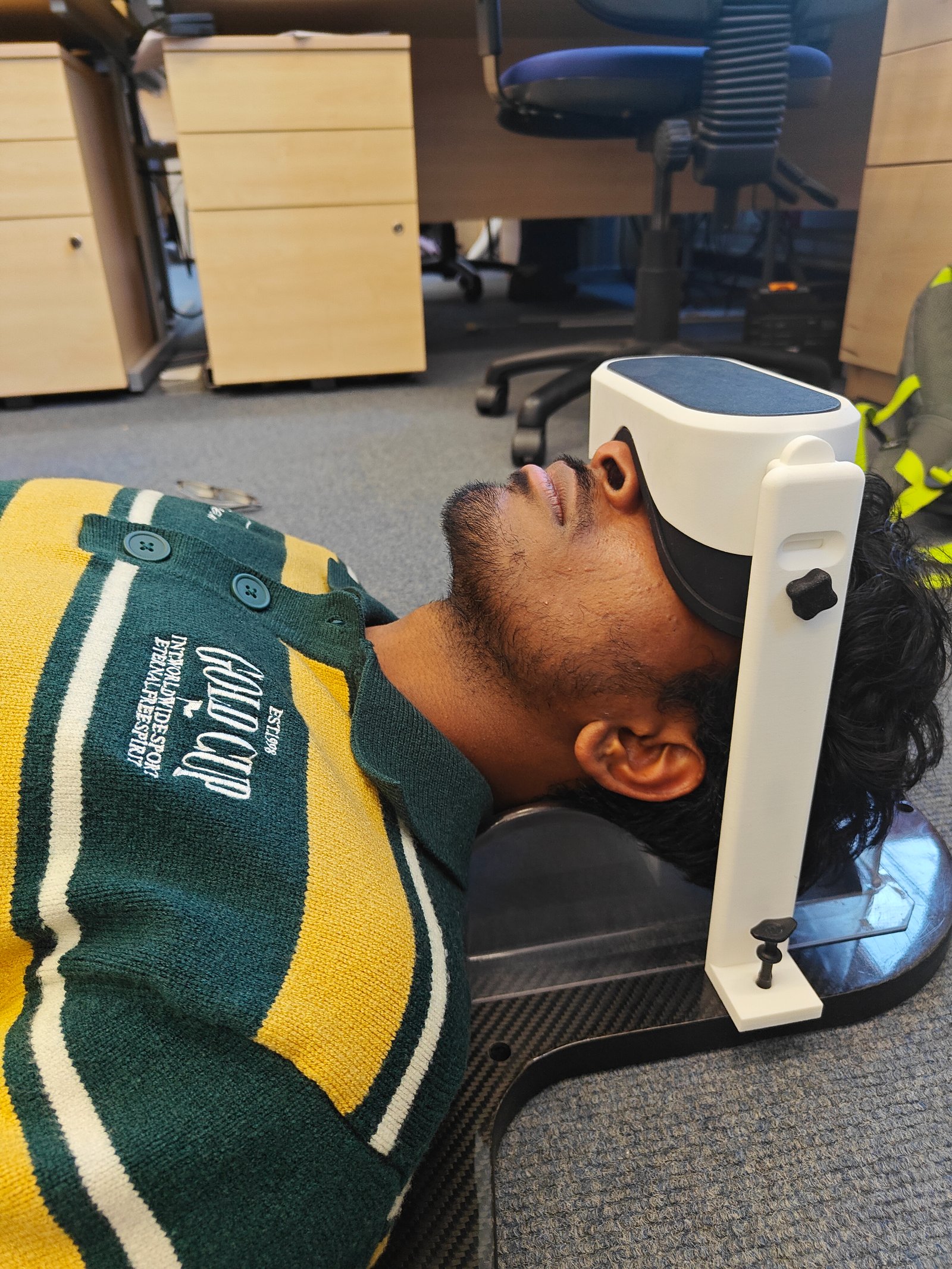
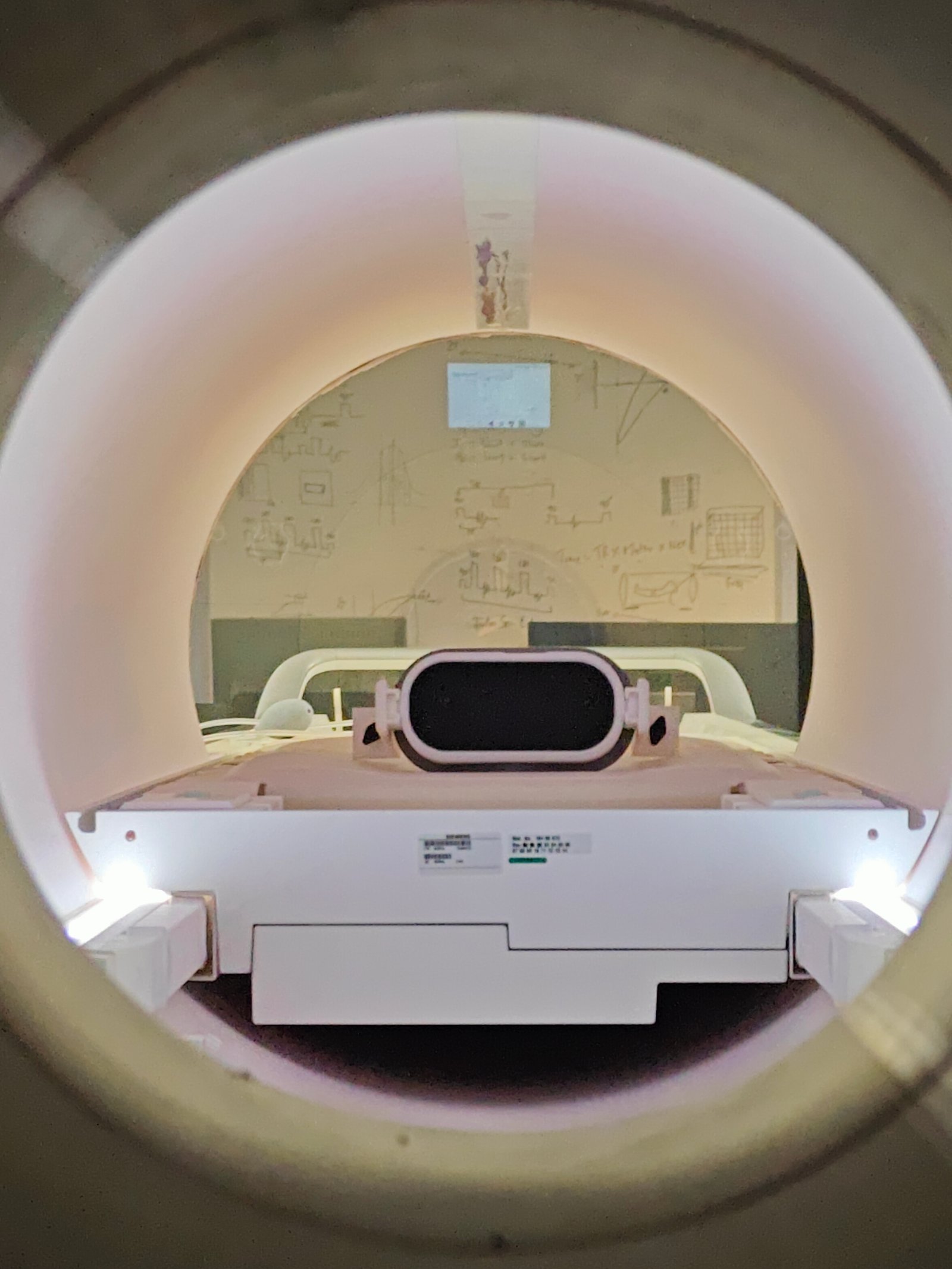
The patient's-eye view, looking up into the bore
Design research
Before drawing anything, I spent time understanding the room from the patient's point of view: flat on your back, staring up into a bore, held in place, unable to move for fifteen minutes at a time. That framing set the brief. The headset had to fill that field of view with something calming and block out the machine, without adding anything the patient had to wear tightly on their face.
It also had to survive two hostile environments. Radiotherapy means high energy radiation, and the planning scans happen inside a strong magnetic field. Both of those quietly rule out most of what a normal VR headset is made of, and that constraint shaped every decision that followed.
Design iterations
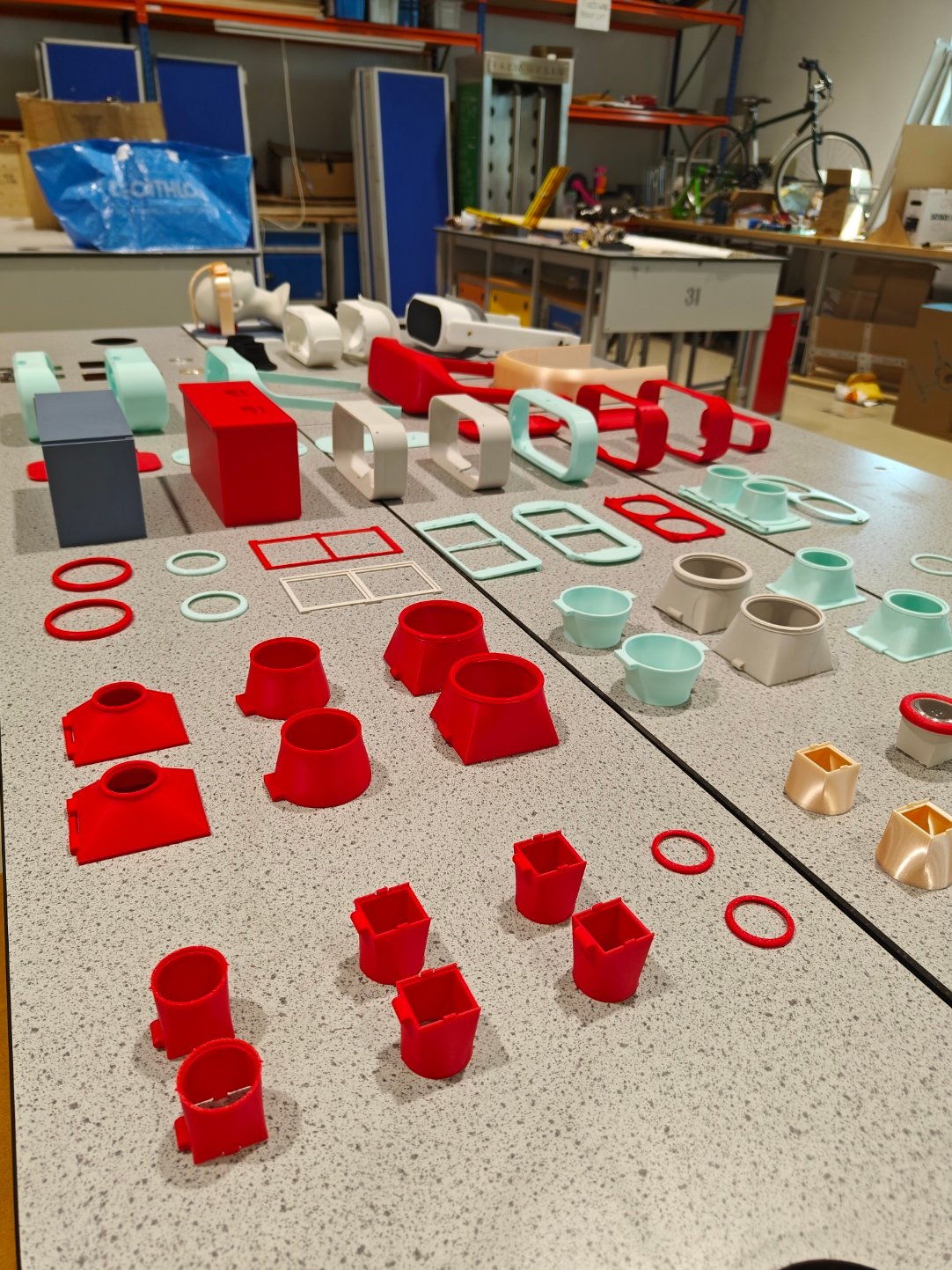
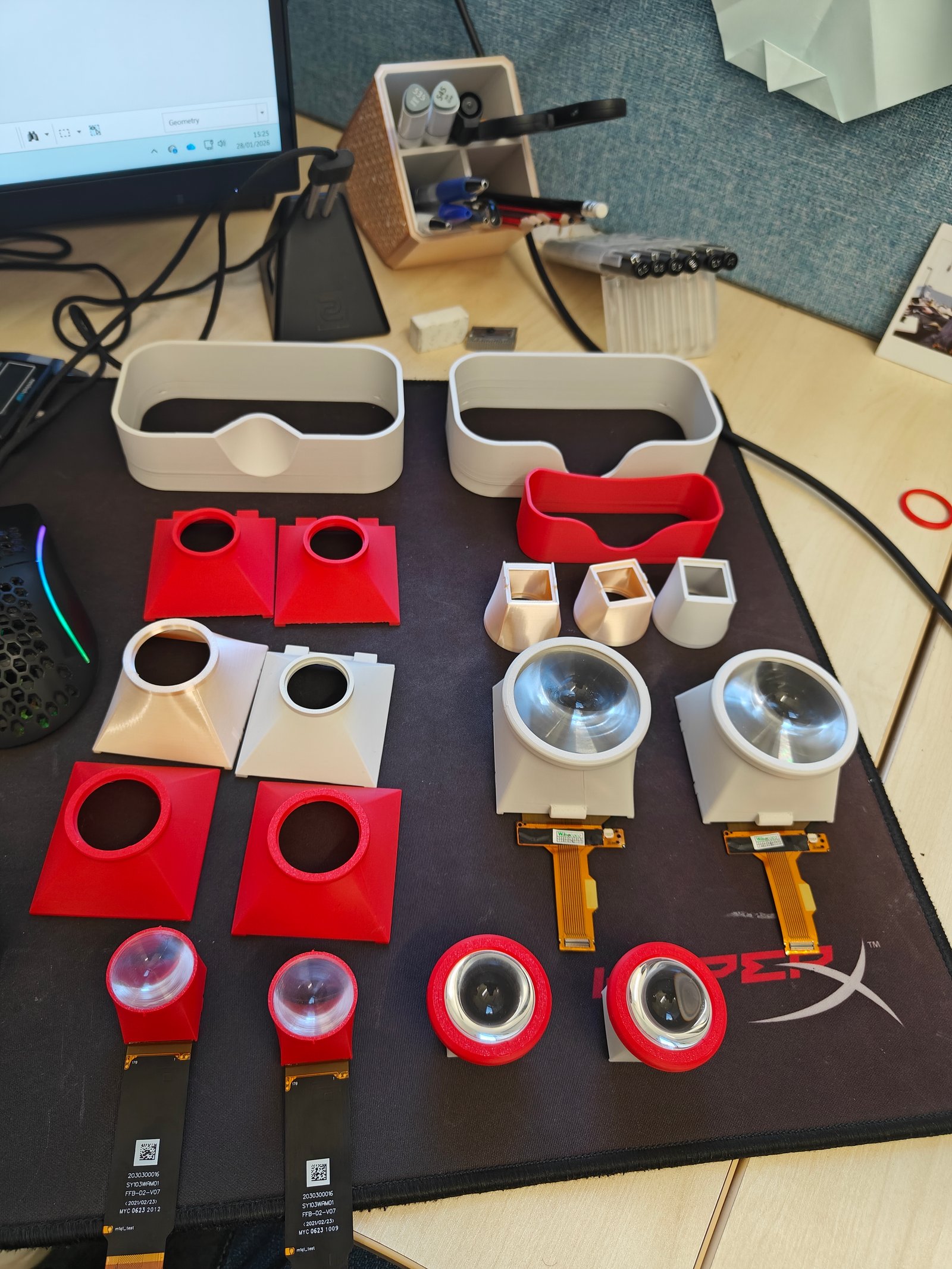
From there it was a lot of printing and trying. I worked through housings, lens cones, shrouds and fixation bands, printing each version, checking it against the optics and the head, and cutting what did not earn its place. The bench filled up with the history of the idea.
One bench, many iterations: housings, lens cones and mounts
Band study 01Band study 02Band study 03
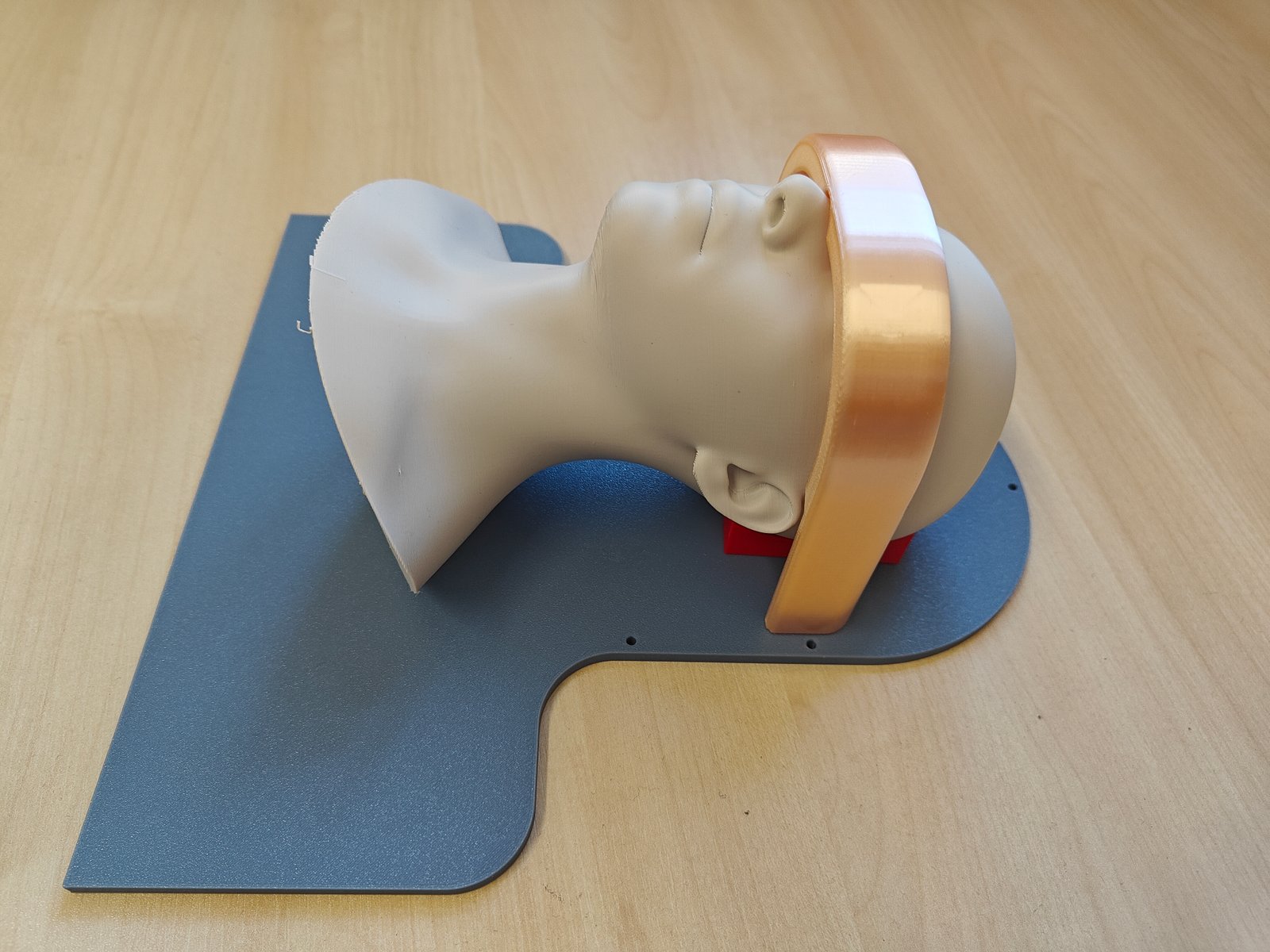
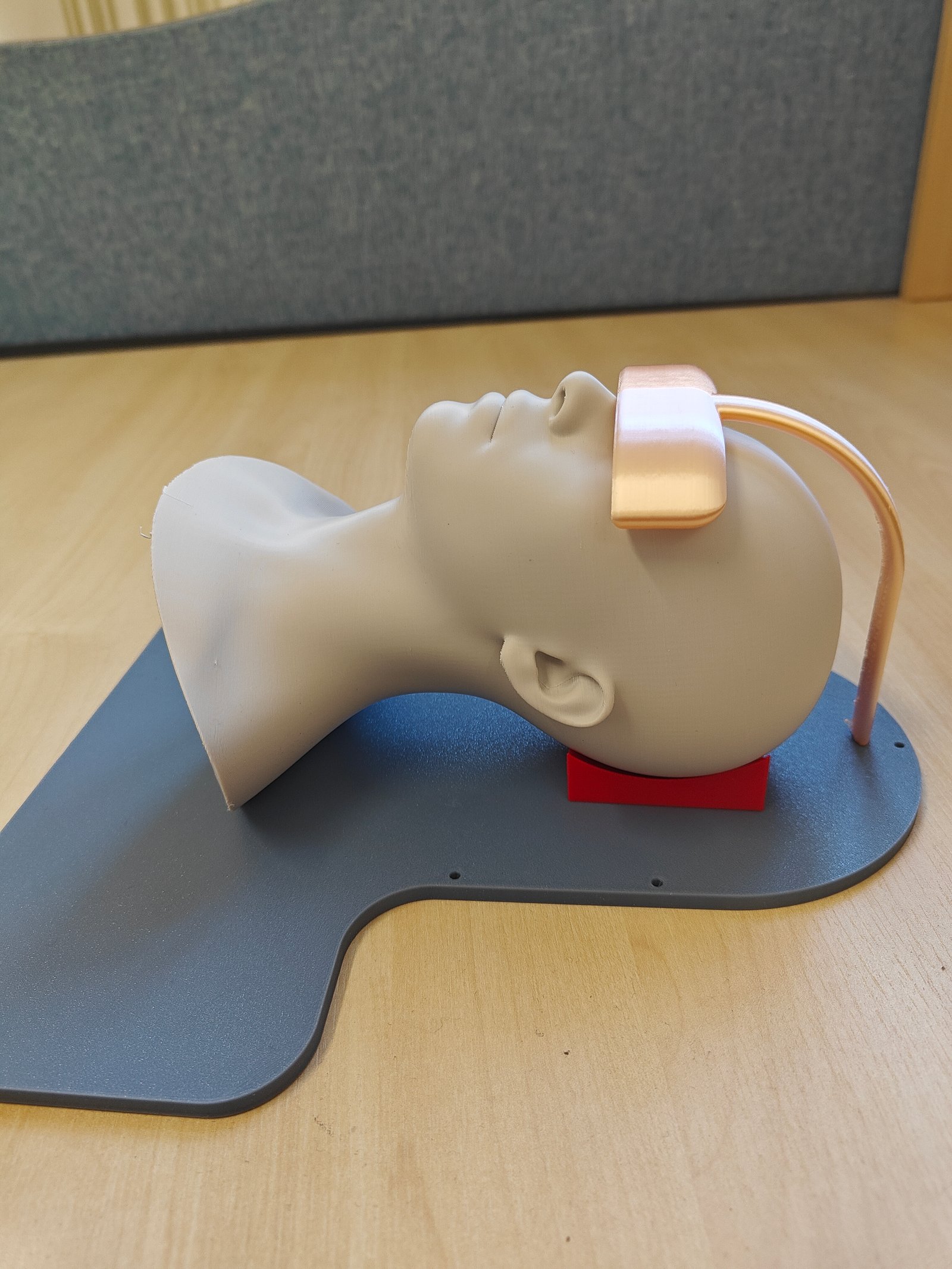
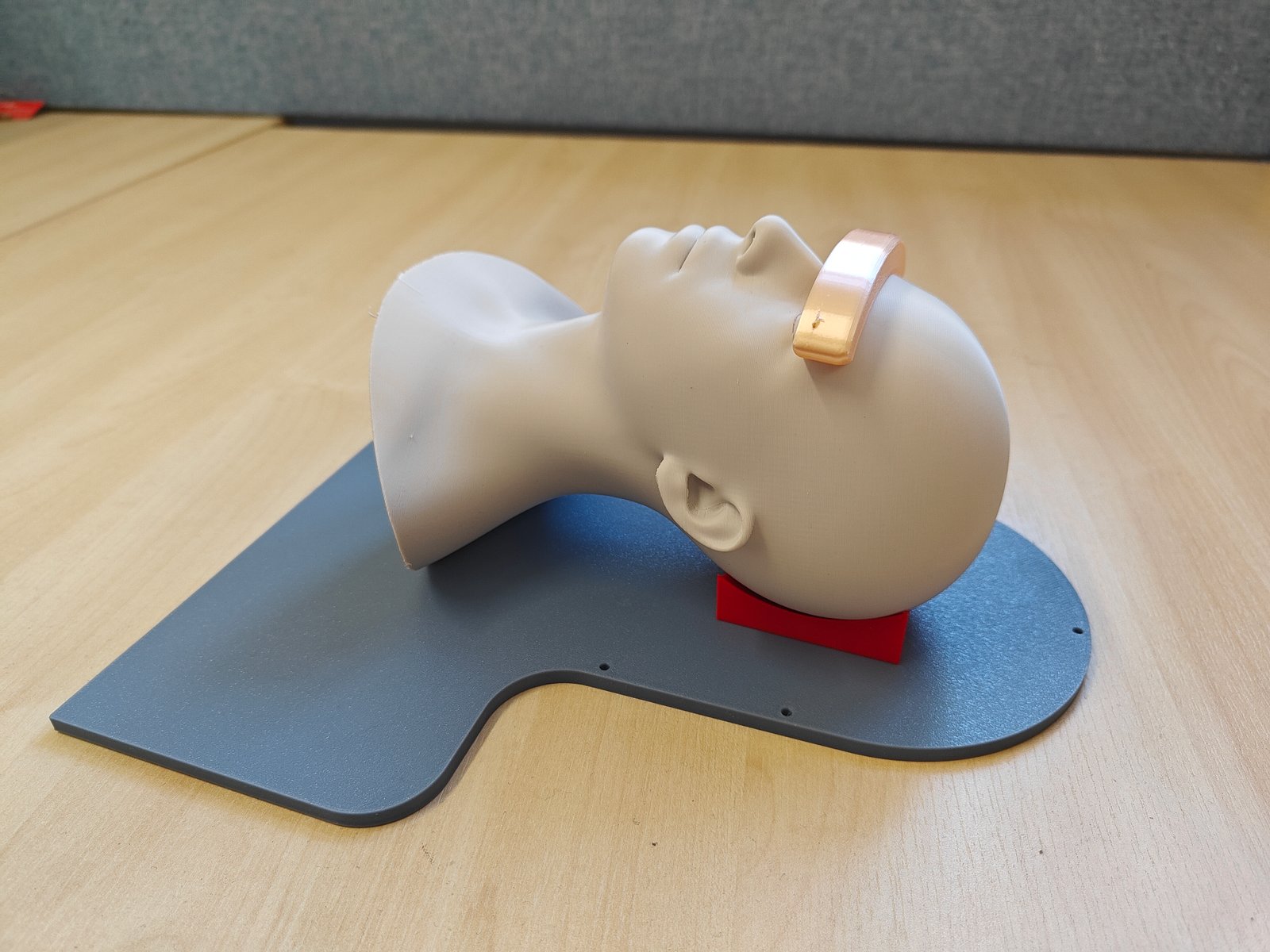
I ran the fixation-band iterations on an anthropomorphic head so I could judge fit and immobilisation directly. The goal was an open band that holds the head as reliably as the mask does, while leaving the face free and the treatment field clear.
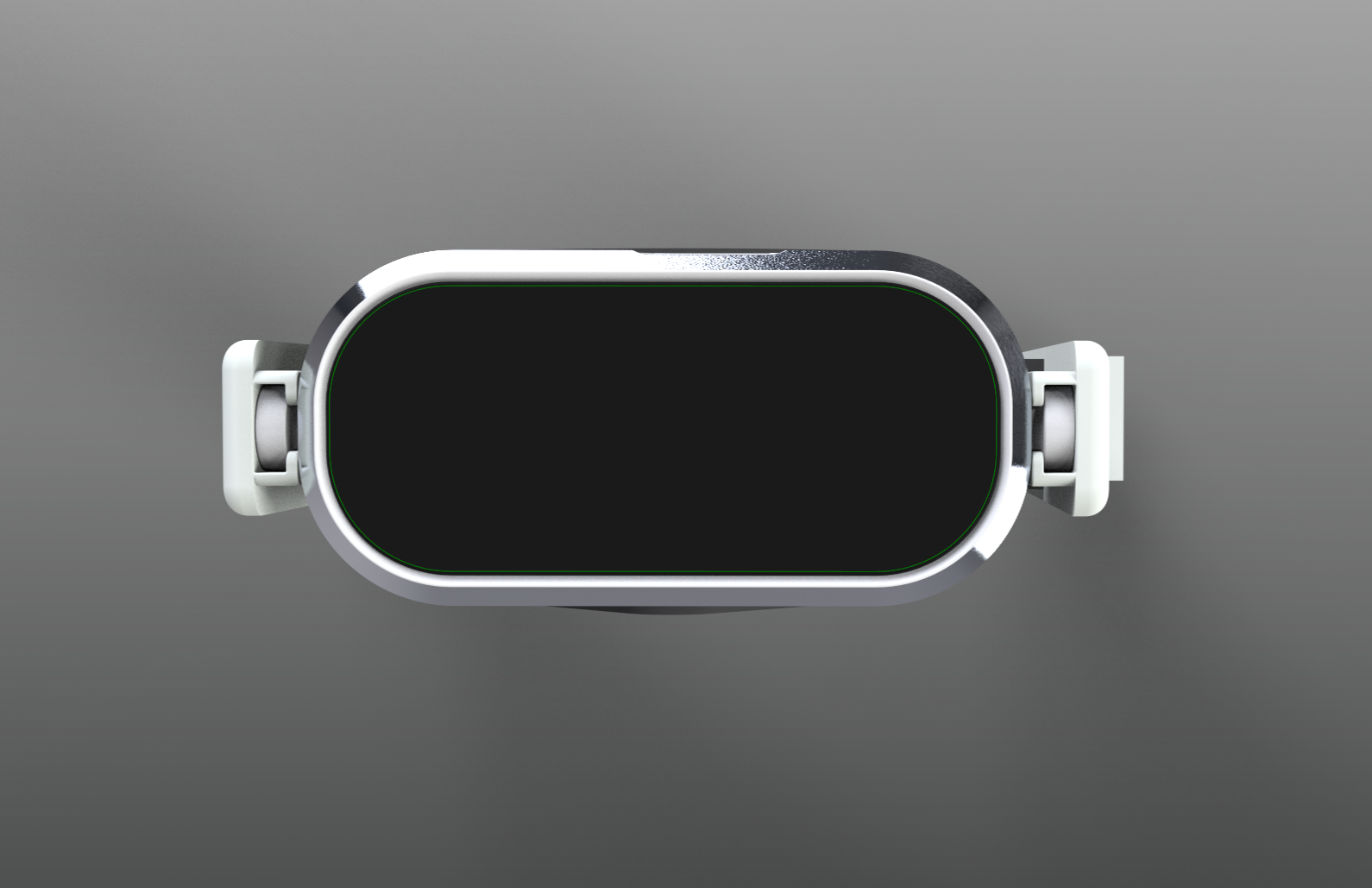
Twin-lens optical path, modelled underside
Conceptualisation & CAD
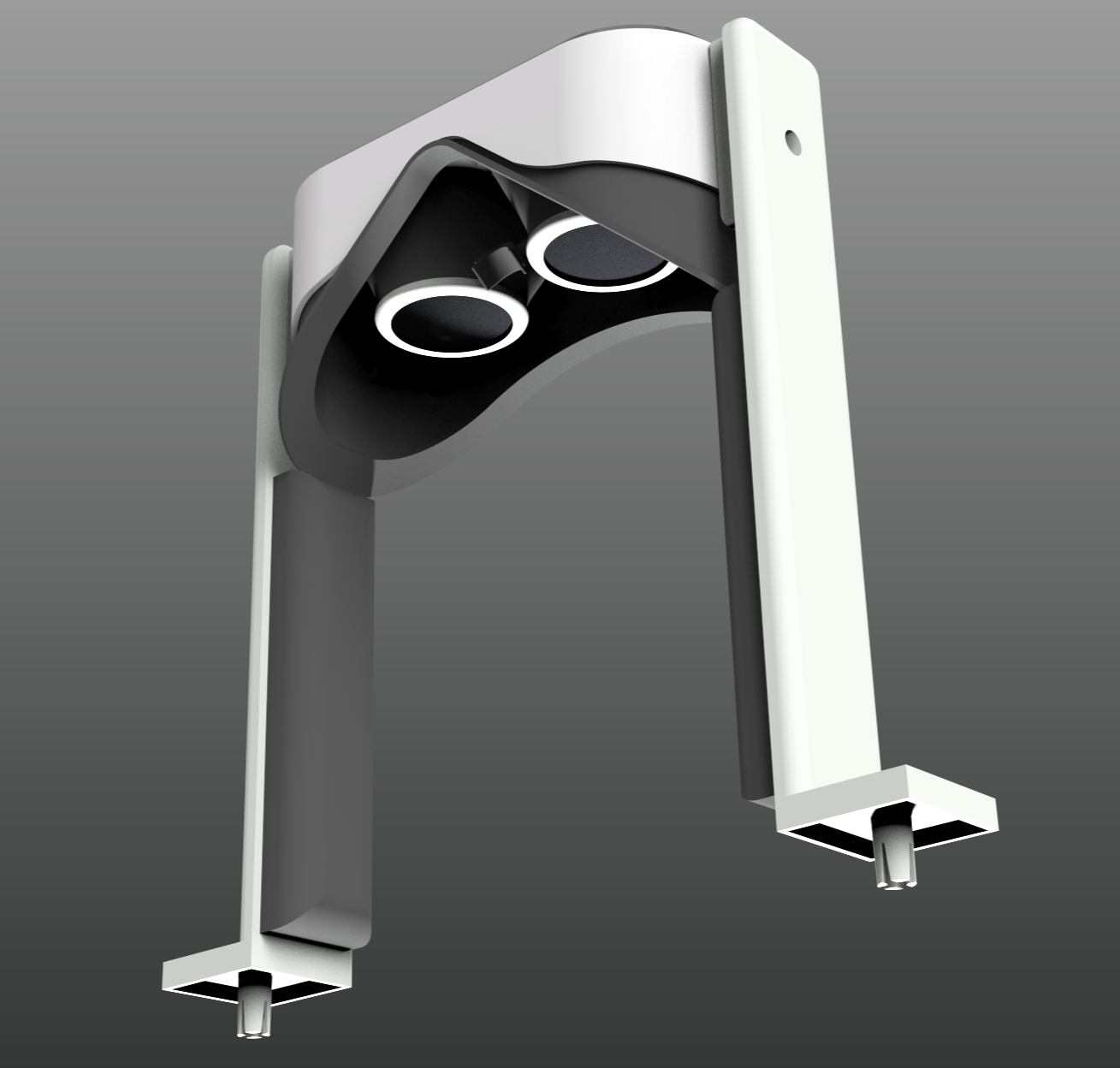
The concept that held up was a headset that stays off the patient. Rather than strapping to the face, IRIS is carried on a floating-arm stand that lifts the display just over the eyes and mounts to the couch board, so its weight never rests on sore skin and the arms clear the beam path. A soft open band does the immobilising.
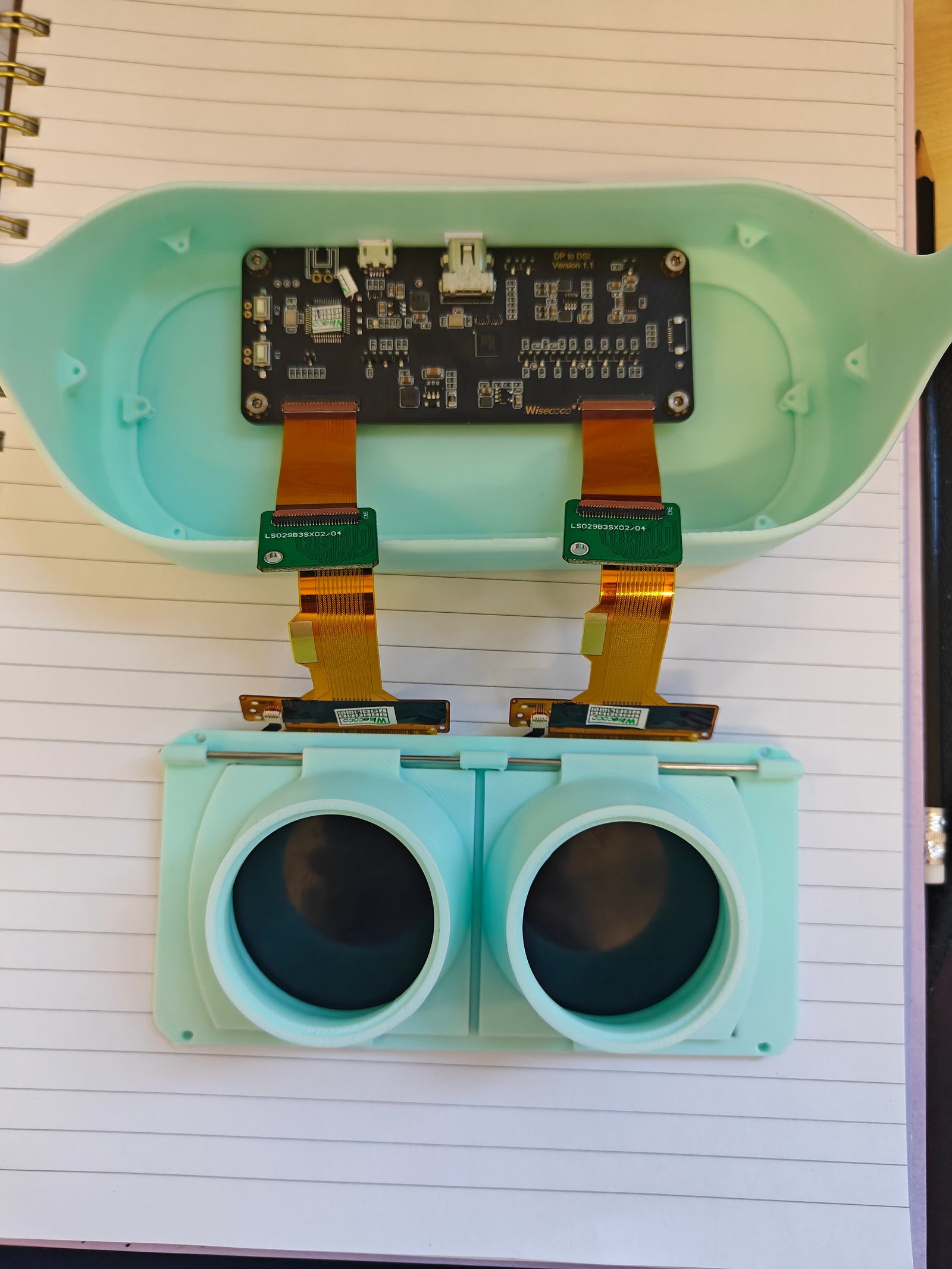
I detailed the whole thing in CAD: the twin-lens optical path, the display housing, the articulating mount and the base board, all designed so the electronics could sit away from the patient and the printed parts could be swapped as the design moved.
Prototyping
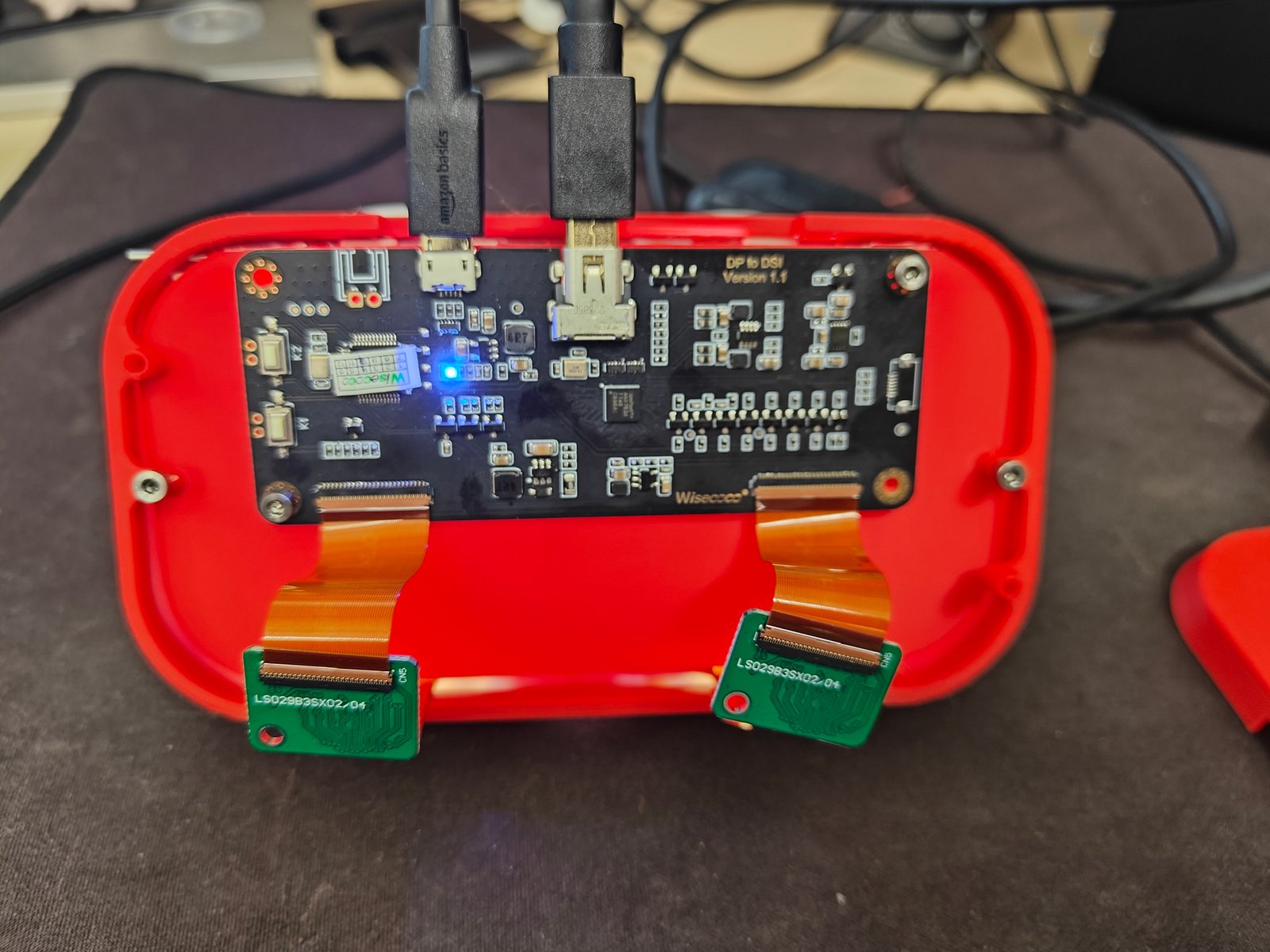
The hard engineering problem was keeping working VR hardware alive next to radiation and a magnetic field. An off-the-shelf headset will not survive it, and stripping one down wipes its firmware. So I rebuilt the display path from parts: dual micro-displays driven by a DisplayPort-to-DSI board, pushed through a lens and mirror arrangement so the sensitive electronics could be moved away from the patient region, and everything near the head made from passive, non-magnetic materials. Audio runs through bone conduction rather than magnet-based speakers.
Optical bench: displays, lenses and cones under test
Driver board and micro-displays, first lightTwin-lens display module in its housing
User trial with the assembled headset on its stand
User & safety testing
The prototype I designed was built to be taken into the clinical trial, so it had to prove itself first. It went through high magnetic field testing for MR compatibility and radiation testing for the radiotherapy environment, confirming the headset can go where the patient goes.
Alongside that I ran user trials with the assembled headset on its stand, checking the fit, the reach of the arm and the comfort of lying under it, the ordinary details that decide whether an anxious patient will actually accept it.
The immersive world, built in Unreal Engine
VR Environment design
The hardware only matters if what the patient sees is worth looking at. I designed the immersive environment in Unreal Engine: a slow, quiet landscape under an aurora and a ringed planet, paced for someone lying still and trying to stay calm rather than someone playing a game.
It gives patients somewhere to put their attention through the breathing and visualisation that the research says helps, turning fifteen fixed minutes staring at a machine into fifteen minutes somewhere else.
"This could help patients relax more and make it a much less foreboding experience, particularly for those with anxiety."
Head & neck cancer survivors' group, on the IRIS concept
Outcomes
I delivered a clinical-trial-ready headset for under £4,000, against a £20,000 equipment budget, saving £16,000, roughly 80% of the allocation, by designing and building the optical and display system rather than buying it. The work was presented at the UKIO 2026 conference in Liverpool, and a research paper is being written on it.
<£4k
to build a trial-ready headset
80%
of the equipment budget saved
£16k
saved of a £20k budget
MR + RT
safety tested for both environments
UKIO 2026
presented in Liverpool
Paper
in progress
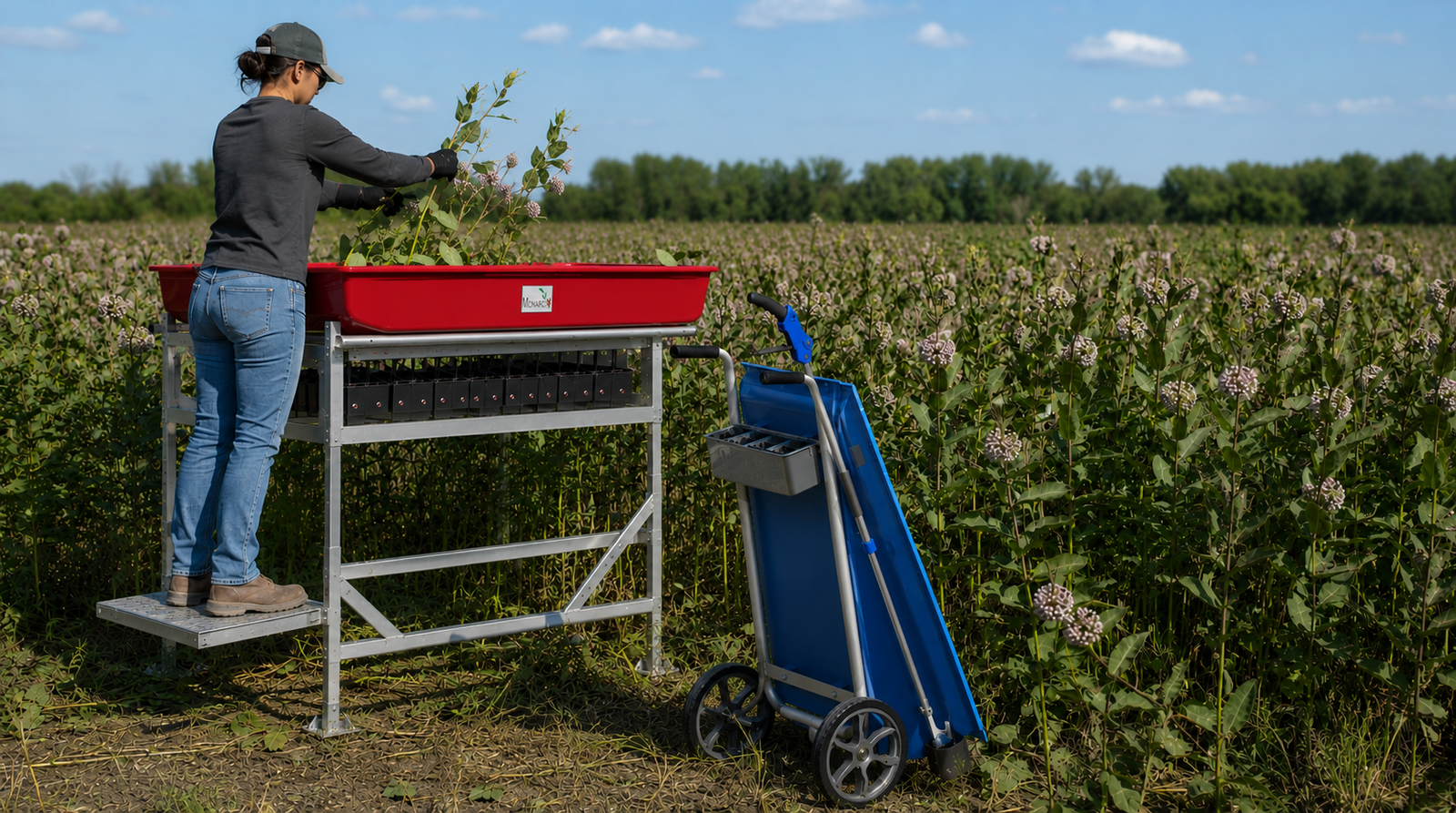
Monarch milkweed picking station · cut, sort and collect from standing · University of Liverpool
Product design · MSc dissertation · University of Liverpool
Monarch: a wheeled picking station that controls an invasive weed without chemicals.
University of Liverpool · MSc Product Design & Management · 2024
Common milkweed spreads fast and is hard to pull by hand, and the usual answer is weedkiller. My MSc dissertation was a full product-design programme for the alternative: Monarch, a mobile wheeled station with a dedicated picker device that cuts and collects milkweed stalks from a standing position, no bending and no chemicals. It is named after the threatened Monarch butterflies that depend on common milkweed for food and nesting. I took it from a Product Design Specification through concept selection, detailed CAD, materials and a full bill of materials to a manufacturing-ready virtual design.
Role
Product design engineer
Focus
PDS → concept → detail design
Tools
CREO · CES Granta · 3DS Max
Where
Liverpool, UK
Product designCAD & mechanismDfMA & BOM
The problem
Common milkweed (Asclepias syriaca) is a perennial that spreads aggressively through seeds and deep-rooted rhizomes, which makes it hard to control once it takes hold in a garden or lawn. The common fix is chemical weedkiller, but home pesticides are linked to roughly 50,000 poisoning cases a year in the US and stay active in the soil for years after use. The manual alternative, uprooting or cutting each stalk at the base with secateurs and a wheelbarrow, means constant bending, and no single product on the market did the whole job.
87%
of UK households have a garden to maintain
~50k
home pesticide poisoning cases a year
£6.5bn
UK garden-tool market, up 32% in five years
0
existing products solving it end to end
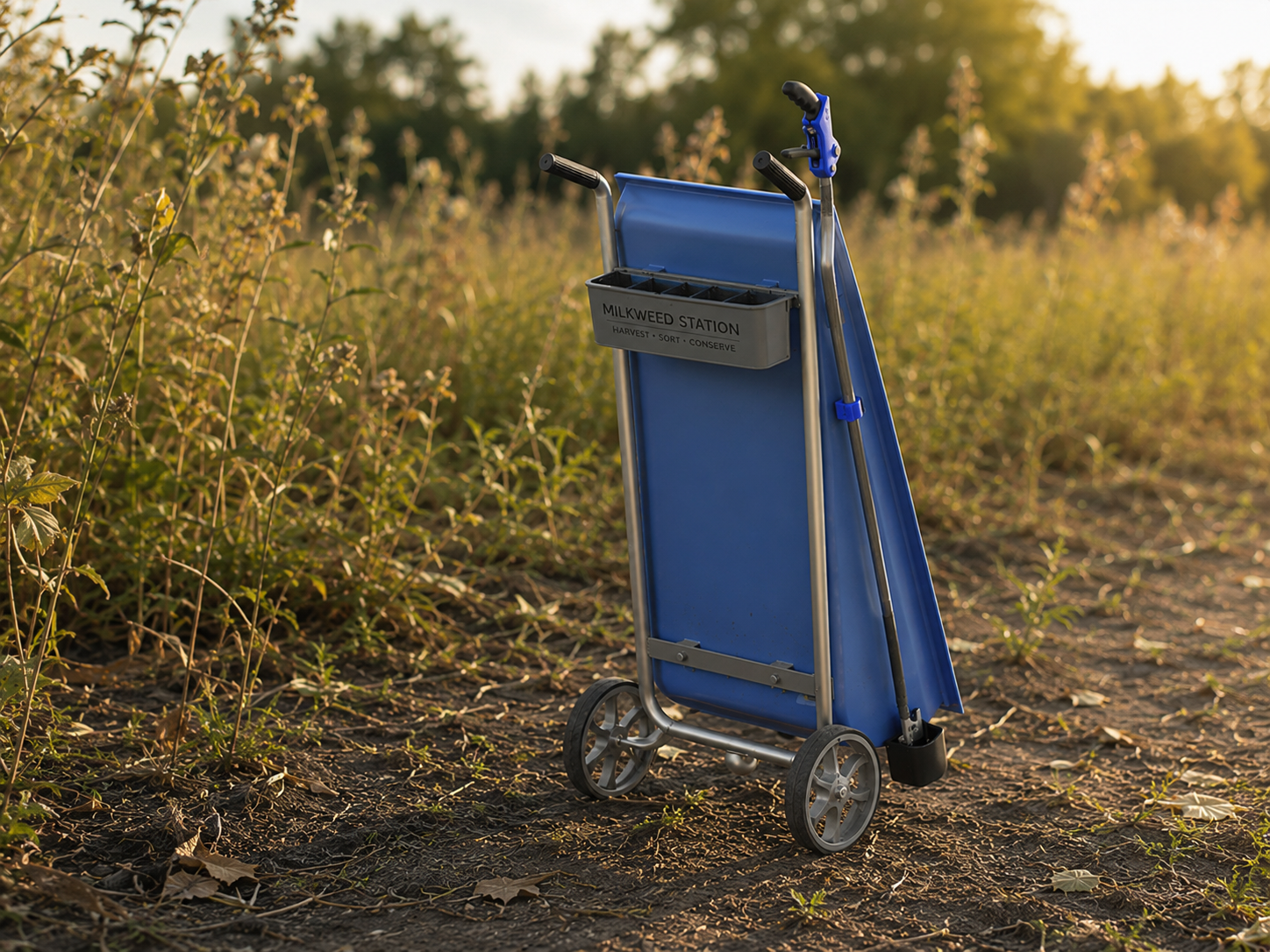
The receptacle station, folded upright for storage
The brief
Design a mobile, user-friendly station to control milkweed: a dedicated picker device that cuts and holds the stalk, feeding a wheeled receptacle that collects it, with the whole task done standing up. It also had to earn its place as a general garden cart, not a single-use tool, so I built in a multipurpose accessory bracket, side tool mounts and a safety guard for the cutting head.
Everything sat under a Product Design Specification, with market and competitor analysis and a review of relevant legislation setting the boundaries before a single concept was drawn.
Concept development
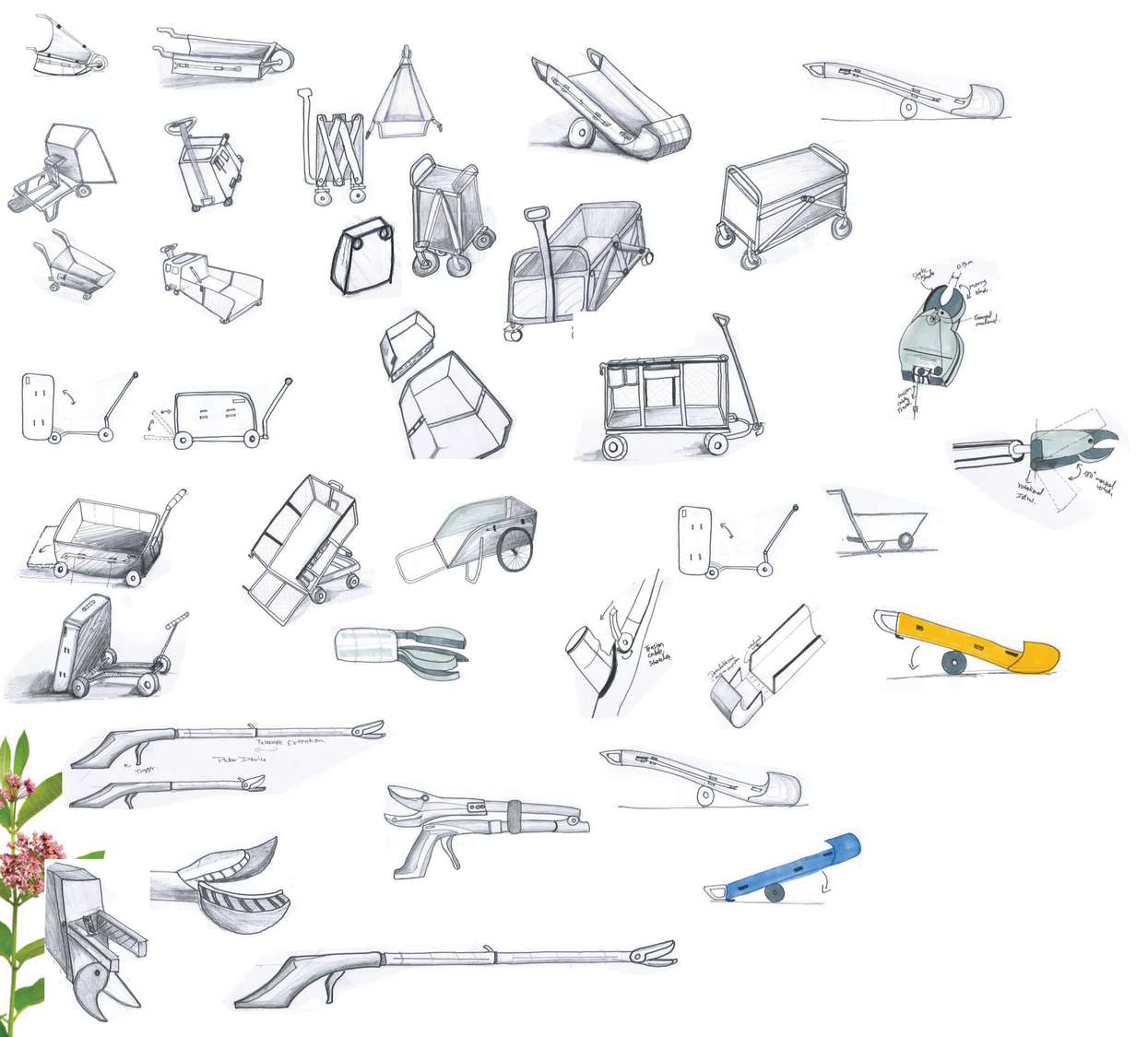
I followed Pahl's systematic method: break the product into a function structure, generate solution principles for each sub-function, then combine them into concept variants. Brainstorming and the function-structure tree fed a discursive solution-principle table, which I combined into ten concept variants covering picker type, cutting and holding mechanism, frame, movement, wheels and seed sorting.
Concept development · brainstorming and solution-principle sketches
The ten variants went through a Concept Variant Analysis using a Pugh matrix, scored against 21 weighted criteria with a traditional wheelbarrow-and-secateurs setup as the datum. Concept Variant 7, an upward-grip picker on a pole feeding a tiltable station, scored highest and was carried into detail design.
Post-interim refinement
Supervisor feedback drove four decisions that simplified the product before detailing began.
1000mm
Shorter, lighter picker
The picker pole came down from 1500 mm to 1000 mm, and the station footprint from 1500×1000 to 1000×500 mm, for easier handling and storage.
−1 gearset
Geared → tension cable
The soft, hollow milkweed stalk did not need a spur-gear cutting head. I replaced it with a torsion-spring and tension-cable mechanism, cutting parts, cost and maintenance.
Upright
Stores standing
A front rest-stopper on the chassis brought the station upright so it stores on its end rather than sprawling like a wheelbarrow.
+ USPs
More than a weeder
The upright frame opened room for accessory brackets and tool holders, so Monarch doubles as a general garden cart.
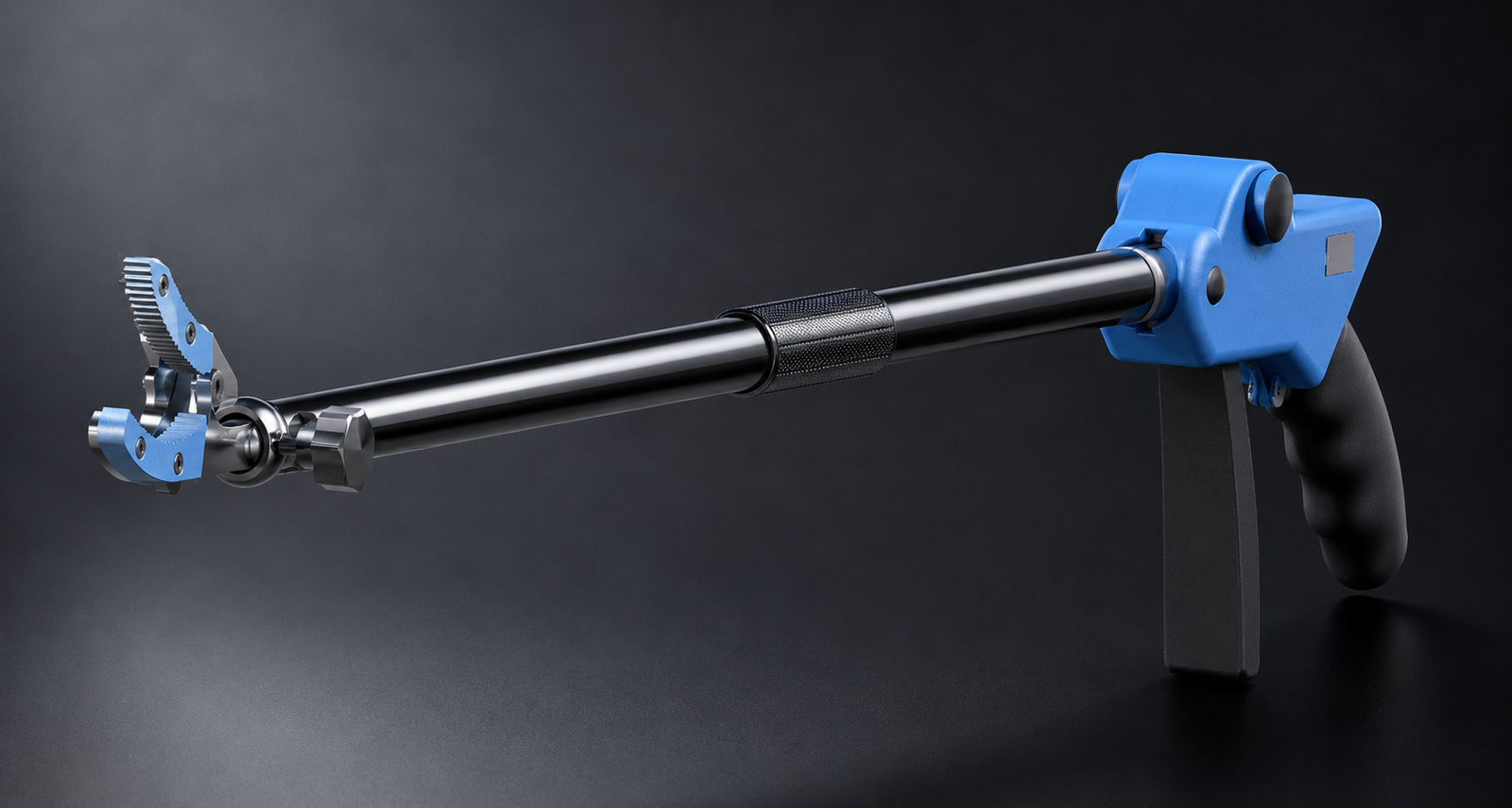
The picker device · trigger handle, telescopic pole, cutting head
Picker device
The picker lets you cut and grab a stalk one-handed, at arm's length, without stooping. A trigger lever in the handle pulls a tension cable down the telescopic pole to drive the cutting head, with a torsion spring returning it. The handle was sized from hand anthropometrics for a range of grips.
I detailed the whole assembly in CREO Parametric: handle body and lever, pole, cutting head, and the cable and spring that link them.
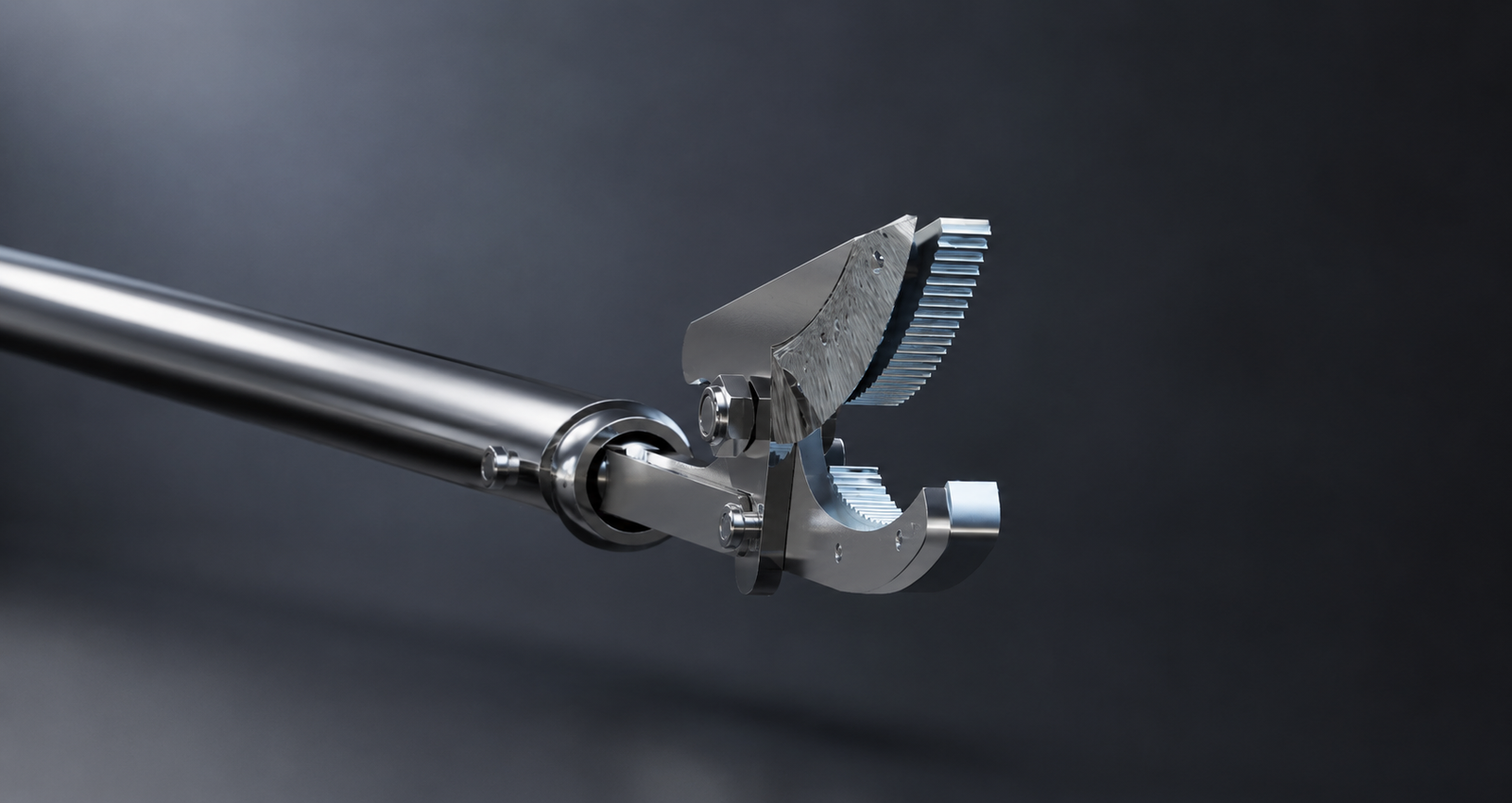
Cutting head · blade with offset upper and lower grips
Cutting head & grip
The head does two jobs in one squeeze. Upper and lower rubber grips, offset by 12.7 mm, press and hold the stalk first, then the blade cuts it, so the severed stalk stays in the jaws to be carried back to the station instead of dropping on the ground.
Because the stalk is soft and hollow, a simple blade beats a geared cutter, which is exactly why the mechanism was simplified.
The stalk is soft and hollow, so it never needed precision gears. Swapping them for a torsion spring and cable cut parts, cost and maintenance in one move.
The design decision that shaped the product
Outcomes
I delivered a complete, DfMA-compliant virtual design for the Monarch station and picker: full CAD in CREO, material selection through CES Granta, technical drawings and a bill of materials, plus draft analysis for the moulded body and an accessory system with four drained tool pockets, side mounts and a blade guard. The picker and station let a gardener cut, hold and collect milkweed entirely from standing. The clear next steps are mould-flow analysis, further part reduction for sustainability, and physical prototyping to validate the design at scale.
10 → 1
concept variants down to one, via Pugh CVA
2
subassemblies: picker device + receptacle
No stoop
cut, hold and collect from standing
Full
BOM, drawings & material selection
Zero
chemicals in the control method
DfMA
virtual design, ready to prototype
Product design · Engineering · University of Liverpool
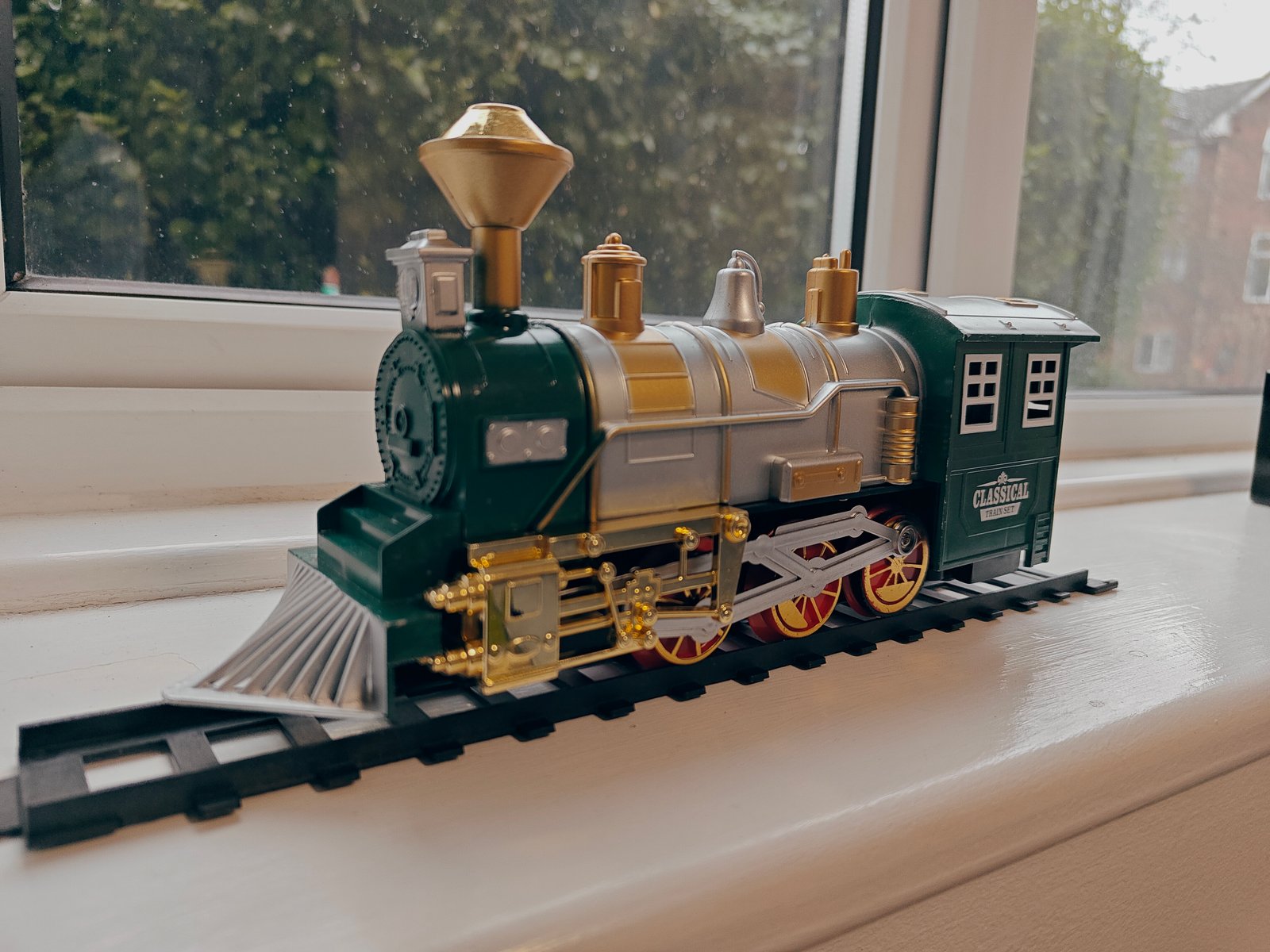
Reverse-engineering a toy locomotive: 34 parts, one working gearbox, all in CAD.
University of Liverpool · CREO Parametric
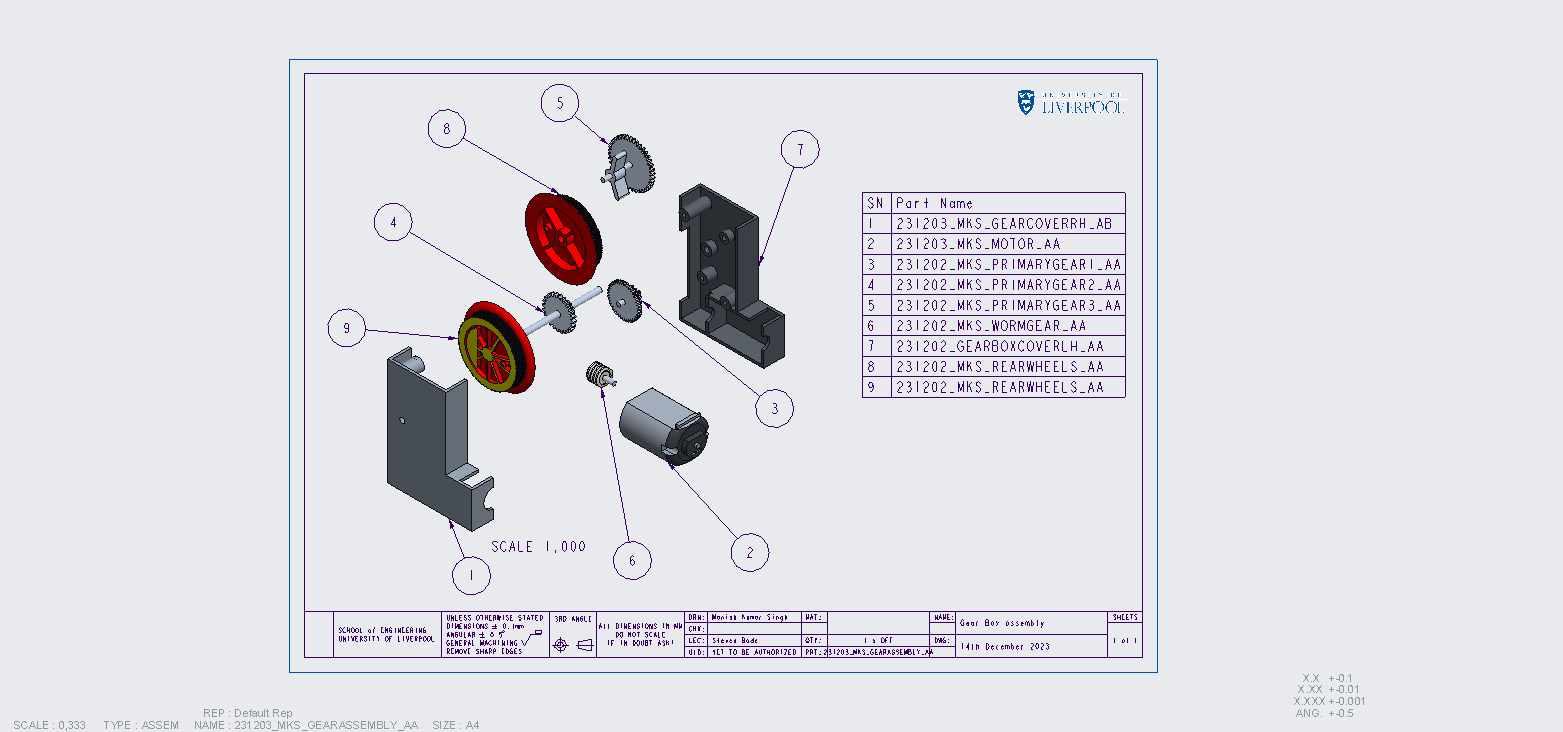
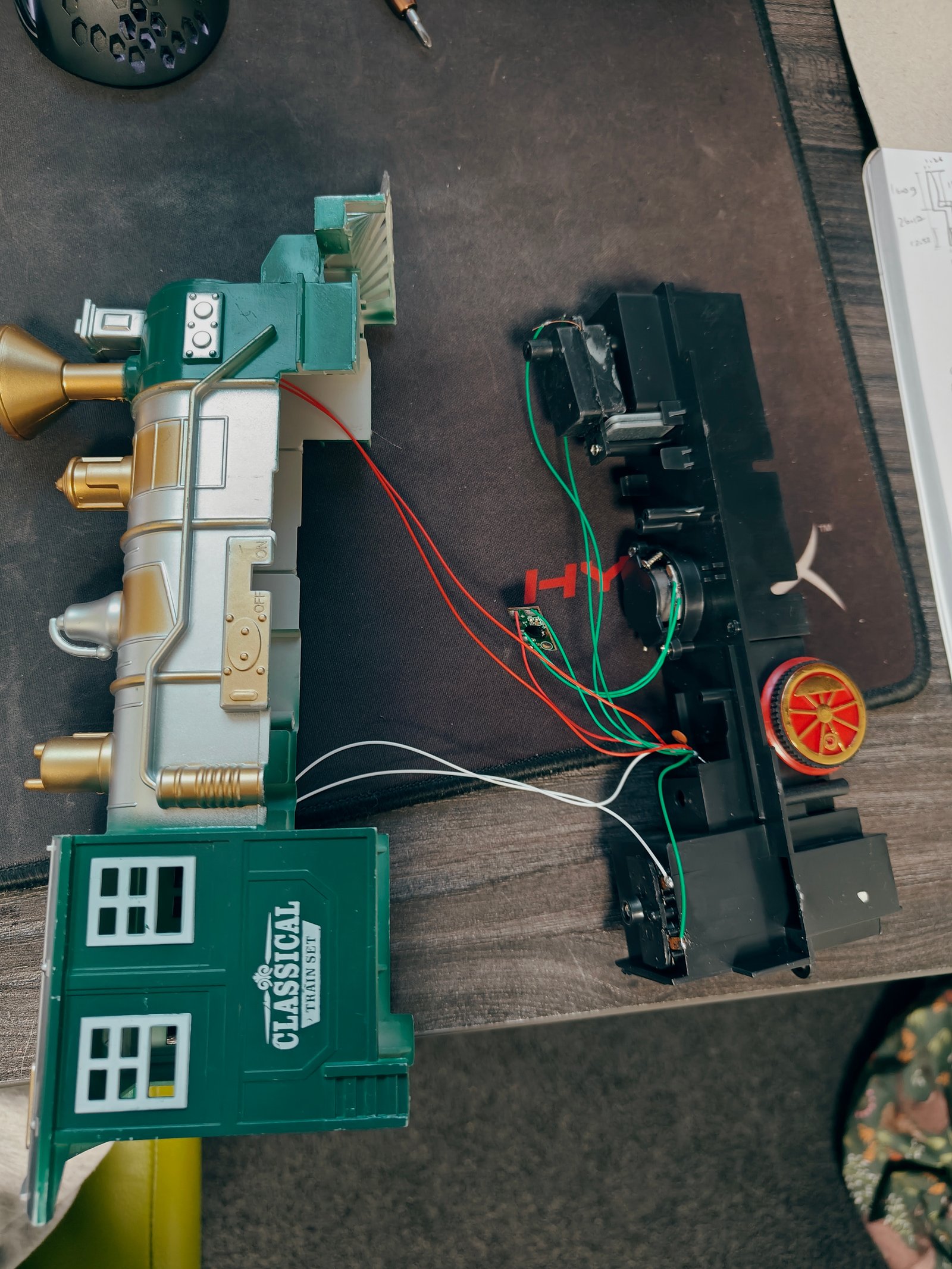
A full teardown-to-CAD reverse engineering study: a commercial deAO Classic Toy Train, stripped to its last screw, measured by hand, and rebuilt part by part in CREO Parametric, right down to a three-stage speed-reduction gearbox that turns in simulation.
Select a production-standard product with embedded electronics and at least one moving component, then reverse-engineer it entirely in CREO Parametric, from disassembly and measurement through to a fully constrained 3D assembly and detailed 2D drawings. I chose the deAO Classic Toy Train: a motor coupled to a speed-reduction gearbox driving the wheels, plus a speaker, headlight, and smoke generator.
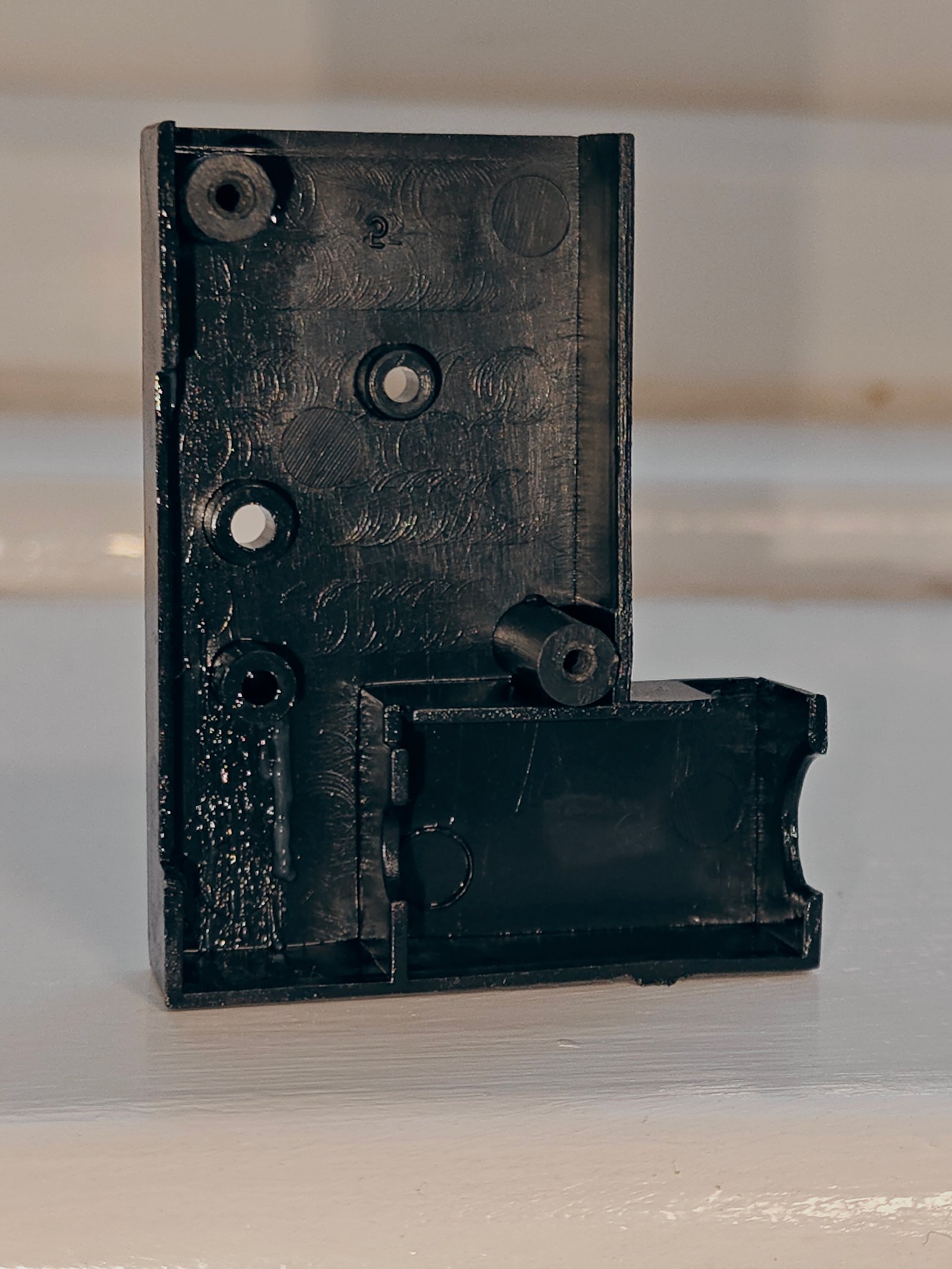
Disassembled the product into 34 individual parts, logging each against its parent part and fastener so it could be rebuilt cleanly afterwards.
Mapped the assembly hierarchy, covering battery box, gearbox, top body, switch and circuit sub-assemblies, to decide what became a sub-assembly and what stayed an individual part.
Measured every component by hand with a digital vernier calliper, taken in parallel with the modelling.
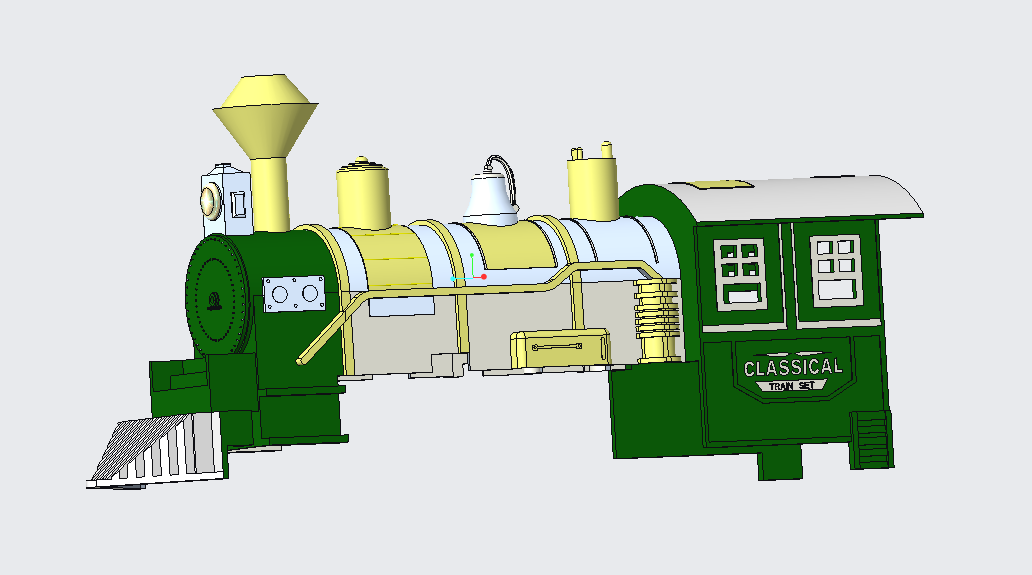
Modelling the body
The locomotive body is a single freeform part with a lot of detail. I built it with Shell for the hollow wall, Blend for the angled roofline, and Pattern for the repeated front-face and side features, adding datum planes to sketch on the cylindrical boiler. A Split Body let me colour the two-tone shell separately, and the "Classical Train Set" lettering was sketched and extruded to match the original.
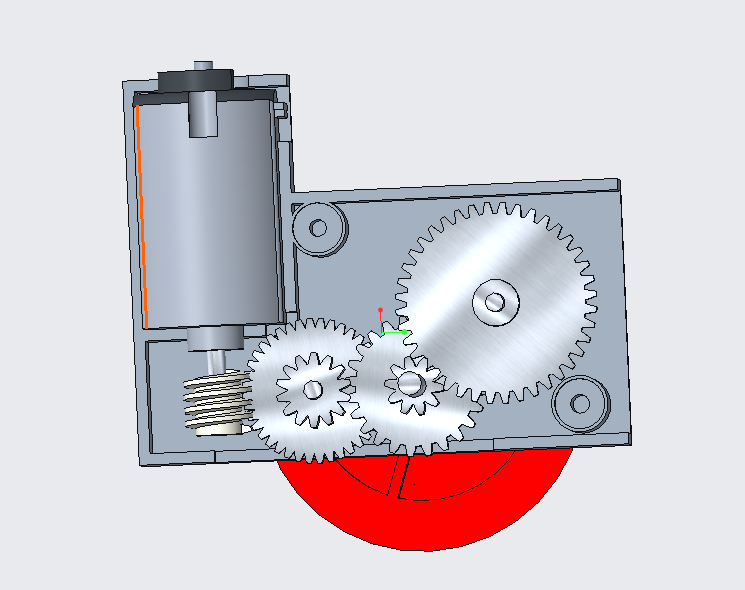
Gearbox & live mechanism
Modelled the worm gear with a Helical Sweep at the measured 1.4 mm pitch, and the three spur gears from a single tooth profile driven around with the Pattern tool.
Assembled the train with Pin constraints and defined gear pairs in CREO's Mechanism application to give the correct reduction ratios.
Added a servo motor and ran a playback analysis so the motor, gear train and wheels turn together, plus a slider mechanism for the on/off switch.
Developing human-centered products from concept to manufacture.
4D Products · Consumer and medical · UK
Two years at a UK product-design consultancy, taking briefs across consumer and medical industries from sketch all the way through to manufacturing-ready files. CAD, prototyping, DFM, and the daily work of translating client ambition into something a factory can actually build.
Role
Product designer
Focus
Consumer + medical
Where
United Kingdom
Product designConsumerMedical
Full case study in progress
Selected projects from my time at 4D Products are being written up. Check back soon.
Vivid · educational AI companion · University of Liverpool
Product design · University of Liverpool
Vivid: an educational companion that fits in a child's palm.
University of Liverpool · Educational toy · UK
A soft, glowing sphere pitched as "more than a friend": a companion for children aged 6 to 12 that listens, teaches, plays and watches over their wellbeing. Designed as a flagship toy for V.M. Toys Ltd, I ran the full programme from market research and concept through CREO 9.0 CAD, BOM and prototyping to the final render.
Role
Product designer
Focus
Concept → presentation
Where
Liverpool, UK
Scope
Educational toy · ages 6–12
Product designCAD & CMFBOM & DFM
The problem
Lonely, isolated children carry lower self-esteem, poorer concentration and a higher long-term risk of anxiety. The brief: a toy that nurtures, guides and above all keeps a child engaged. Furby, Gilobaby and Tobbie could talk or move, but none adapted, understood emotion, or taught. Vivid fills that gap.
11.3%
of 10–12s often feel lonely at school
27%
of lonely young people struggle to focus
6 roles
friend, teacher, guardian, therapist and more
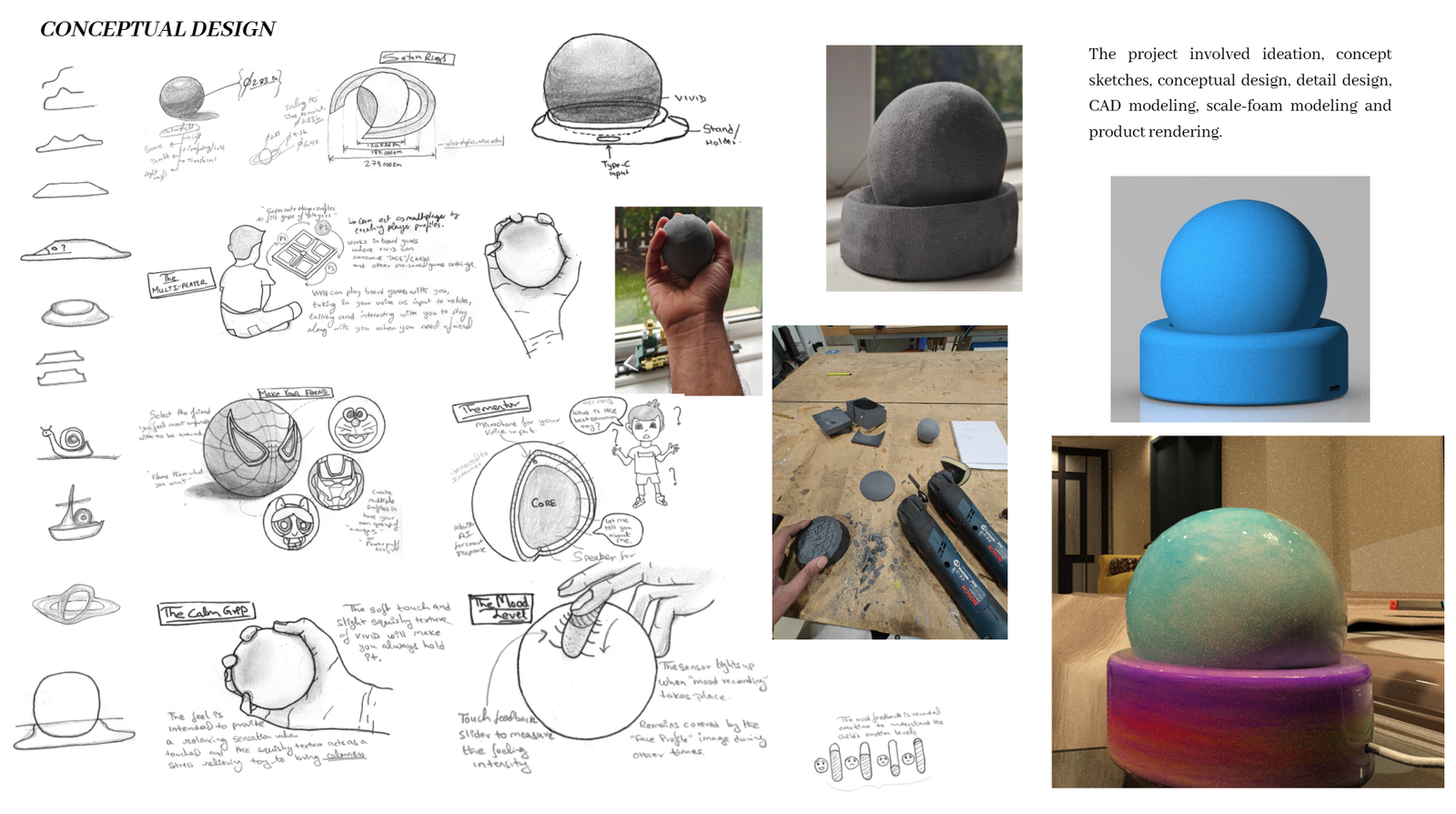
Sketches → scale-foam model → first CAD
Conceptual design
Rounded, palm-sized forms, sketched until the sphere-on-a-base landed. Sized from small sports balls to fit a child's hand, then proven as a scale-foam model before CAD.
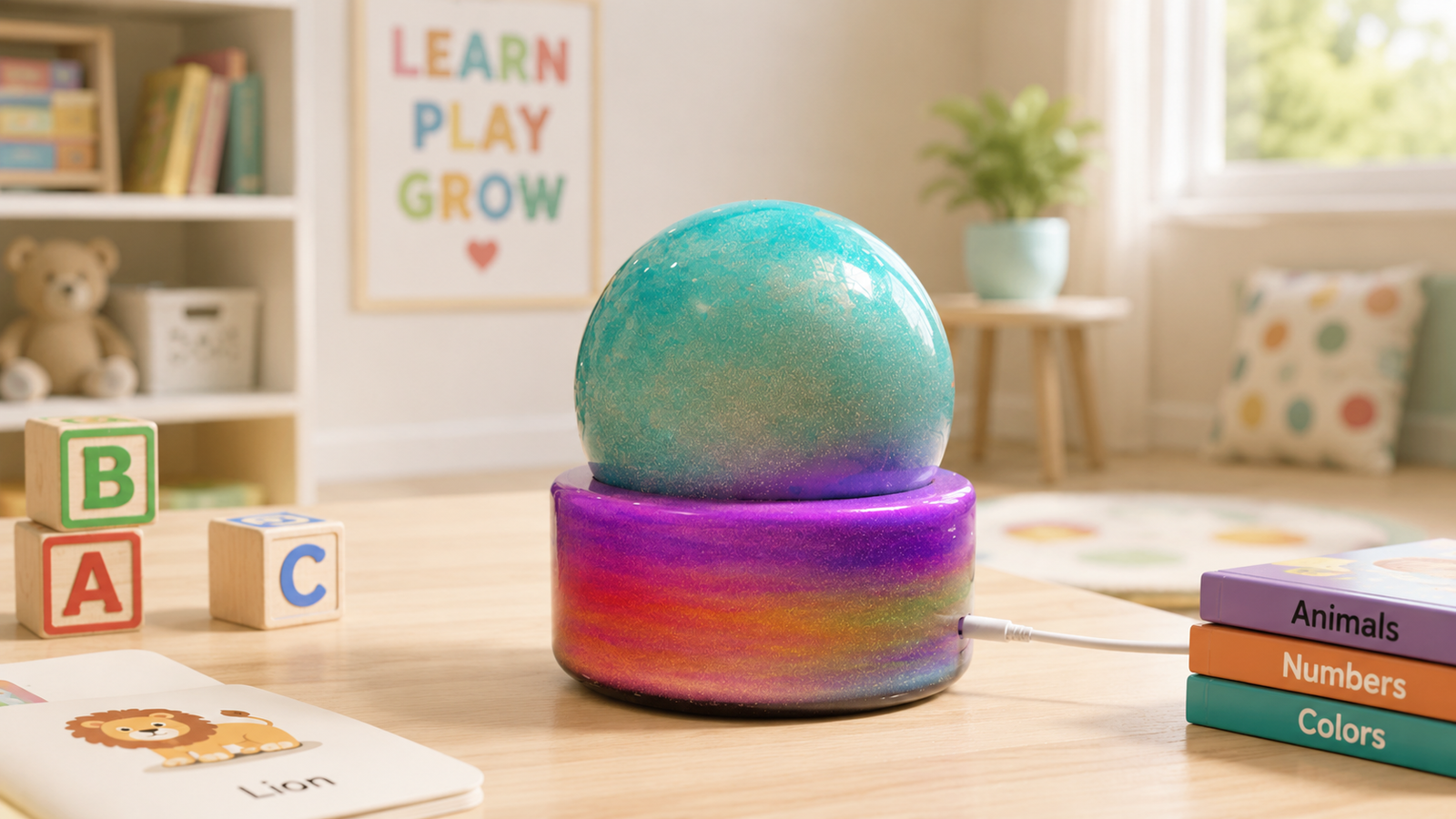
Virtual proof of concept
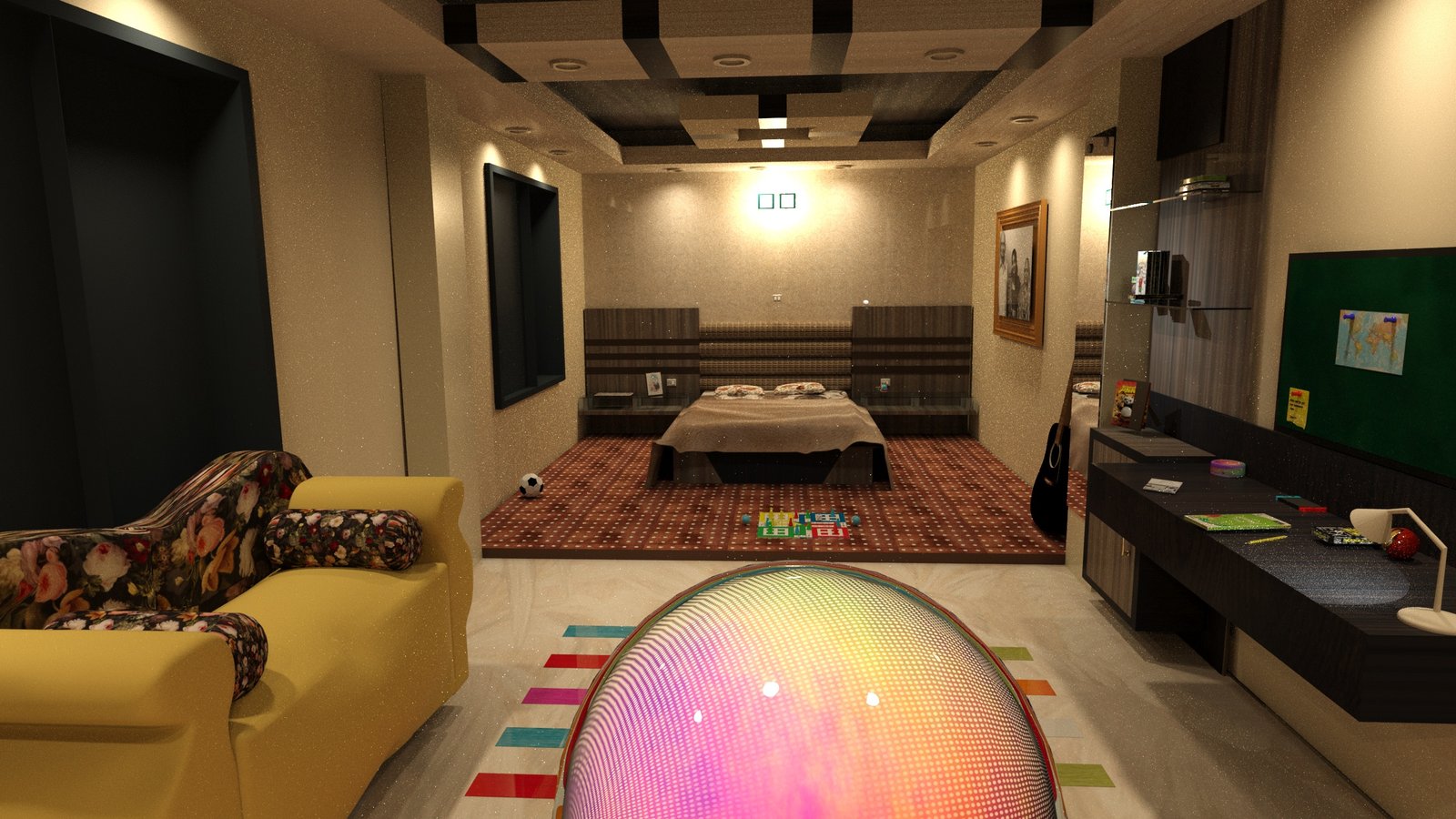
Rendered into the room it is meant to live in, making the scale, glow and presence real before a single part existed.
Vivid, placed in a child's room
More than a friend
Six overlapping roles, so Vivid steps into whichever one a child needs.
Friend
Listens and responds
Hears a child's thoughts through voice and answers so they feel heard.
Teacher
Answers every “why”
An education API returns simple, filtered, age-appropriate answers.
Guardian
Watches for hard days
Tracks mood patterns and alerts a parent via app on negative trends.
Therapist
Nudges toward wellbeing
Suggests calming activities and healthy daily habits from mood cues.
Playmate
Board games aloud
Runs game rules and turns on voice cues, so play never needs a second person.
Entertainer
Fuels imagination
Build your own Vivid from modular pieces and memory sheets.
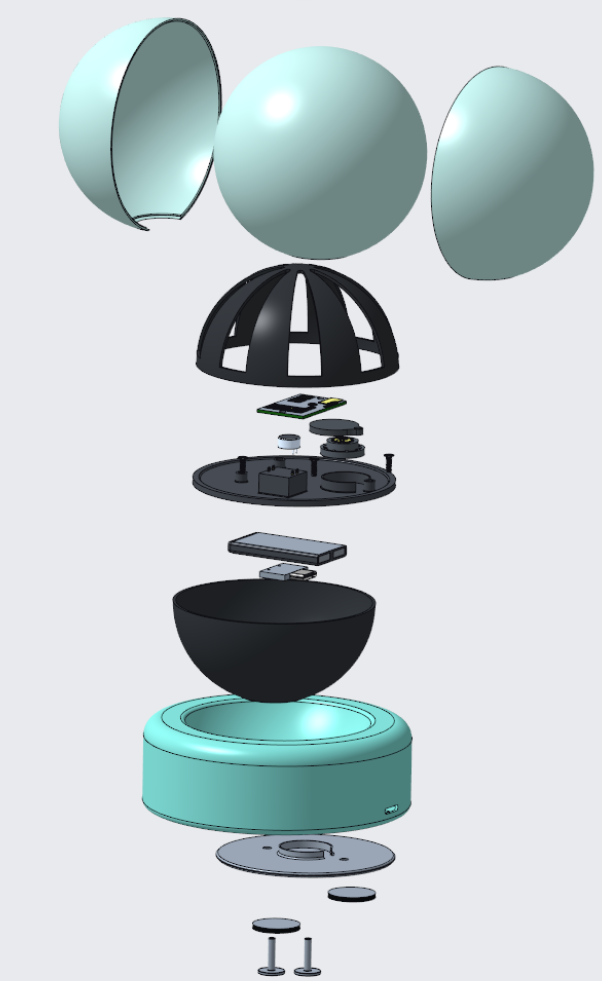
Exploded assembly · CREO 9.0
Detail design & CAD
Modelled in CREO 9.0 to DFMA. A split ABS shell protects the electronics and carries the LED face, wrapped in a soft Nylon cover for its squeezable feel.
One main board runs the screen, mic, speaker, accelerometer and Wi-Fi. It charges wirelessly from a USB-C pod into the Li-Ion battery in the lower shell.
Bill of materials
A full 21-line BOM: every part, material and process. Nine parts injection moulded with draft angles, symmetry and rounded edges for clean ejection and safe handling.
21
components, fully specified
9 parts
injection moulded to DFMA
4500 mAh
Li-Ion, USB-C wireless charging
ABS + Nylon
hard shell, soft-touch cover
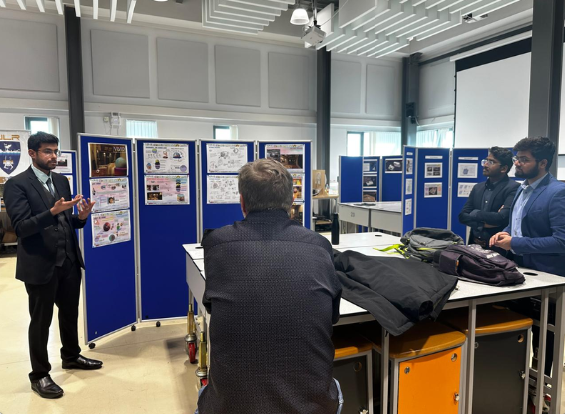
Presenting Vivid at the crit
Product presentation
Presented end to end, from first sketch to final render, making the case for why a soft glowing sphere is a genuinely good idea for a child.
Vivid nurtures, teaches and calms, on a low-cost, repairable platform built for a child to grow up with.


 Manufacturing